Sunday, August 25, 2019

Trivia Post 11

I am working on another post, so putting some long-pending trivia notes.

1. The poster of Lakshya is brilliantly made and conveyed many things. The tag line, the shadow of a soldier, and the progressively bolder style of words showing determination (Lakshya).
2. I finally watched 500 Days of Summer and what is clearly visible in the film is the color blue associated with Summer. She is almost entirely in blue throughout the film. Her costumes, her room, her accessories—all are blue. There is even a song where everything turns blue. Like it did in Tumhi Dekho Na from Kabhi Alvida Naa Kehna. There is an interesting theory behind the blue color as explained here.
3. Perfectly adequate in 500 Days of Summer and perfectly average in Ek Main Aur Ekk Tu.
4. Ending credits of Kaalaakandi.
5. Shaad Ali in Dil Se.
6. Love is never ready-made in Stree
7. The colors of the posters of FAN and Mission Mangal are quite similar. 
8. Ayan Mukerji has said that Dil Chahta Hai was the one film that changed his life. So, in his first film, he names his lead character Sid after Sid from Dil Chahta Hai, and like him, he also falls in love with an older woman. Tara and Aisha are older in age to the men. In Yeh Jawaani Hai Deewani as well, he took inspiration from Dil Chahta Hai where Ilahi had shades of Tanhayee
9. Mani Ratnam is a rare filmmaker who has consistently shown the intimate relationship of married couples in his films—Roja, Bombay, Guru, Raavan, Yuva, Iruvar, and Alaipayuthey (Saathiya).
10. In the visually stunning Super Deluxe, the most striking thing that pops out in its every frame is its color palette. Every scene is shot in the three primary colors—red, blue, and green. Even the costumes in different stories follow this pattern. 
11. Wearing the clothes of the lover in Lootera and Wake Up Sid.
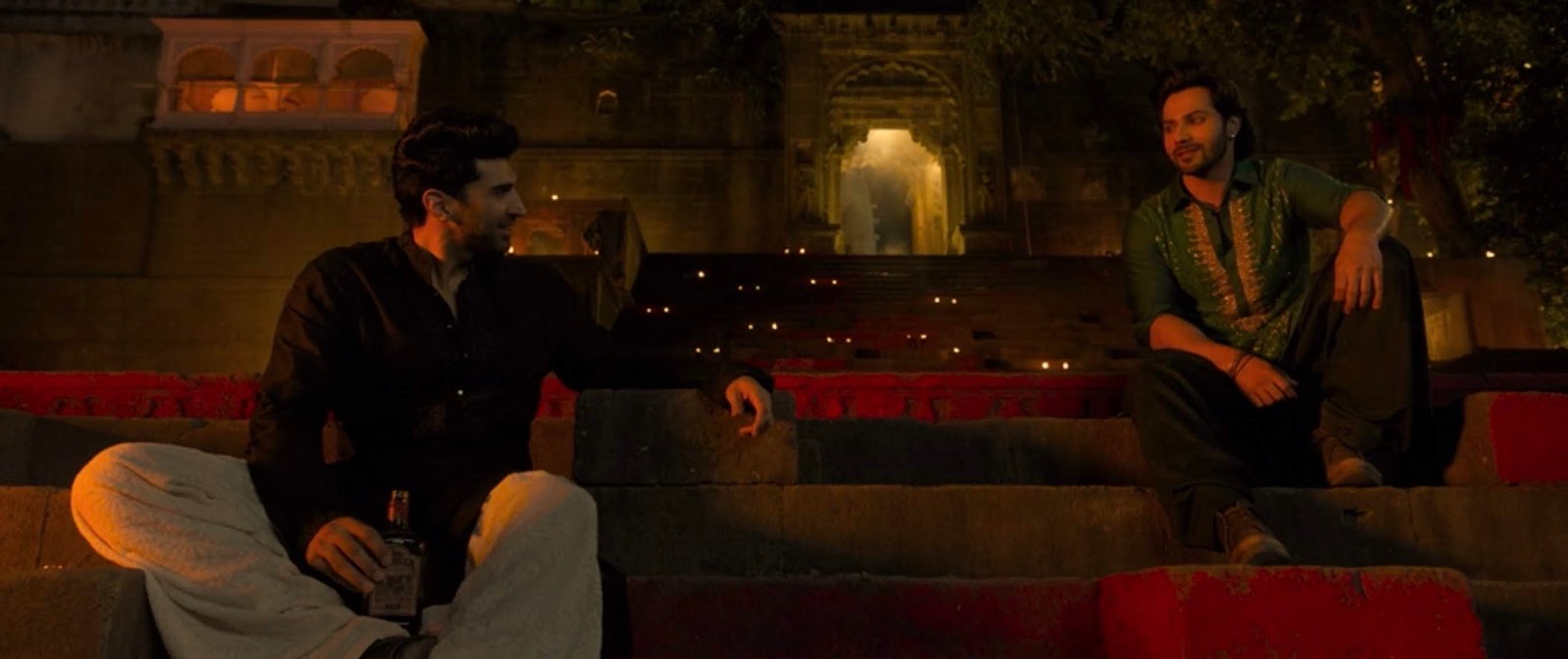
12. The below scene in Kalank is reminiscent to the one in Hum Dil De Chuke Sanam where the husband and the lover, unaware about their identities, talk about the same woman.
13. Aditya in Jab We Met and Meera in Jab Tak Hai Jaan mend the broken relationship with their respective mothers after they themselves fall in love. It is their own love life that helps them understand the love life of their mothers. In Dil Chahta Hai, Akash mends his relationship with Sid when he falls in love. It is only after he falls in love, he could understand Sid's love for Tara.
14. In Ek Hasina Thi and Khoon Bhari Maang, the women take revenge from the men who harmed them using animals, such as rats and crocodiles. While browsing came across this post that talks about scenes of women cutting off their own hair in English films. Ek Hasina Thi can also be added to this list.
15. Recently, Cafe Coffee Day (CCD) was in the news. In Queen, Vijay breaks his wedding with Rani in Queen in a CCD. A lot did happen over coffee.
16. Opening credits of Waisa Bhi Hota Hai Part II.
17. In English Vinglish, Shashi learns to speak the word judgemental.
18. Naina and Bunny in Yeh Jawaani Hai Deewani would most likely end up the way Karan's parents did in Hum Tum. They love each other but want different things in life. The future is going to be hard for them.
19. Kyun Main Jagoon from Patiala House and Aas Paas Hai Khuda from Anjaana Anjaani are companion songs. A dejected protagonist asks God about their presence in the former—Jaane Kahan Chhup Ke Baitha Hai Khuda; God responds that they are nearby—Tu Na Jaane Aas Paas Hai Khuda.
20. Meri Pyaari Bindu
21. Jab Tak Hai Jaan
Dialogue of the Day:
"Yadaash bhi kitni ajeeb cheez hoti hai. Kisi cheez ko puri zindagi bhulne ki koshish karo, woh bhulti nahin. Kabhi ek chhoti si cheez yaad karne ki koshish karo, toh yaad nahin aati."
—Samar Anand, Jab Tak Hai Jaan

Sunday, August 11, 2019

Eighteen Years of Dil Chahta Hai

I clearly remember the first time that I heard about Dil Chahta Hai was in the year 2000 during an episode of Kaun Banega Crorepati, then hosted by Amitabh Bachchan. It was a Diwali special episode in which Aamir Khan and Preity Zinta were invited. Aamir had come with a unique look with a goatee and the look prompted Mr. Bachchan to ask him some questions. Aamir told that the look was part of the character of a film that he was working on with Farhan Akhtar. About a year later, the film was released as Dil Chahta Hai on 10th August 2001. I was in class ninth at that time and used to watch movies mainly at home. Only once in a while did I go to the theater to watch a movie. I never got to watch the film when it was released. Even the cable TV guy did not show it. It was only a year later that I got a chance to see the film when the movie premiered on Star Plus sometime during the summer of 2002. I still remember the day when I watched it. I had little understanding of the nuances of films but even then I fell completely in love with the movie. I had never seen a movie like Dil Chahta Hai before, a movie that I could call as my own special one. 
Over the years, I have watched this movie again, and again, and again, and I still cannot get over it. It is difficult to articulate as to what about this movie makes it endearing and personal, yet, I have written the most about this film. Meryl Streep has said, "I have a theory that movies operate on the level of dreams, where you dream yourself." Good movies forge a connection and have a relatability factor in them that helps us see ourselves in them. Dil Chahta Hai is one of the few films where I saw parts of my life. I saw a little bit of myself in Deepa, Sid, Sameer, Shalini, Akash, and even Subodh. 
In a fabulous interview with Madhavi Menon, Farhan Akhtar explained the meaning of the title of the film. The film's title in English is usually translated as The Heart Desires which Farhan Akhtar found quite different from what he meant. He says the real translation of Dil Chahta Hai is Because I Feel Like. He adds, "Anything that happens in the movie is because the person feels like it, so that was a literal translation. They made it 'The Heart Desires', which is quite troublesome. In Hindi, yes, the literal translation would be 'The Heart Desires'. But when you use in everyday language, you don't use it like that. You won't say, kyunki main chahta hoon ki main. You’ll say dil chahta hai—Because I feel like it. 'It' can’t be defined."
In essence, the story of Dil Chahta Hai has been done before, but it the way it has been presented with an urban flair was nothing short of a revolution. Farhan Akhtar’s favorite film while he was growing up was Kranti. His mother said that every morning before going to school, he would watch the film. He would finish it after returning from school. In an interview with Farah Khan, he jokingly remarked that he wanted to bring his own kranti (revolution) to the kind of films that were being made at that time. He wanted to make a film where people behaved normally. And, he did. The film completely changed the landscape of cinema. There is now a time period that is pre-Dil Chahta Hai and post-Dil Chahta Hai. The film is about relationships that have a name. Friendship. Love. And, it is also about relationships that have no name, that cannot be siloed into categories easily. 
Siddharth Sinha, also known as Sid, played by Akshaye Khanna, is one of the most thoughtful male characters that I have seen in Hindi cinema. Farhan has mentioned that it was on the sets of Himalay Putra where he was an assistant director to Pankaj Parashar that he met Akshaye. I have wondered if the characters in our films share traits with the actors who play them. Akshaye is known to be a reclusive and a closed person. He does not open up easily to people. These are also some of the very traits that he shares with Sid.
Sid is a painter by profession. He is the only child of a single mother. We never get to hear about his father, although we do see some black and white pictures of men in his house. Unlike Sameer and Akash who belong to affluent business families, Sid appears to be not as financially well-off as his other friends. He shares a frank and honest relationship with his mother. His mother gave him the full freedom to do whatever he wants, but would he still have been a painter if his father was there? Fathers are, generally, strict and it would be worthwhile to imagine if Sid’s choice of being a painter would have been accepted by his father. His mother does not force him to attend social functions because she knows he will get bored there. She says, "Duniya me aisi bahut kam jagah hai jahan tum bore nahi hote ho." There are very few places in the world where you do not feel bored. At a later point in the movie, she probes him on his plans for marriage. She remarks, "Aaj tak toh tumne mujhse kuch nahi chhupaya," which points out that their relationship is beyond the formal strictness of a parent and child. Contrast this with Sameer, who when stayed back in Goa with Cristine, told Akash and Sameer to not call his home till he returns. Even Akash’s parents have a certain sense of expectation from him that he does something in his life and that he should think about his future. Sid’s mother wants his son to do whatever he wants and never chides him for the decisions of his life. 
Growing up in a home where there is no fatherly figure made Sid’s mother closer to him and they became joint decision partners, and maybe that is why Sid became more mature than someone of his own age. Sid fell in love with an older woman like Tara, who might be closer to his mother’s age than someone of his own age. His maturity makes him fall in love with someone who is like his mental age, and Tara is a perfect candidate. She understands him just in their second meeting by looking at his paintings, which his friends and family, even after knowing him for ages do not. The fact that Tara is also a single parent, who has a daughter and is divorced, also brought a sense of familiarity with his own mother’s hardships and perhaps, that explains why he could relate to Tara, in addition to their complementary professions of an interior decorator and a painter. Sid does not want any kind of sexual relationship between him and Tara and he even has no hope for it; all he wants is to see Tara happy. That explains his anger at Akash, whose consideration of Sid’s love for Tara as a sexual fantasy made Sid furious. 
Akash was always interested in the physical aspect of a relationship and ran away from the emotional aspect. During the fight scene in the film, Akash disclosed, "Meri shuraat bhi aise hi hui thi", perhaps suggesting that he had his first sexual encounter with a woman who was older and experienced than him. Earlier in the film, Akash told Sid that the portrait of the woman he made resembled Miss Kashyap, their economics teacher, and he knew her figure more than Sid and Sameer. Therefore, it is not difficult to disagree with the way Akash reacted when he heard about Sid’s love for Tara. He was bragging about his sexual escapades with older women and his friends never raised any moral compunctions against his philandering ways and thus felt that Sid, too, was following his footsteps. Some part of the way he reacted can also be explained by the way Sid spoke his words. Sid said that he did not want Tara to become his nor he wanted her to marry him, which was just like the way Akash thought about his relationships. It made him believe that Sid was also interested only in a physical relationship with Tara and he has no issues with that. That is why, Akash said, "Agar aisi baat hai to mujhe koi aitraaz nahi hai. Vaise bhi tere liye perfect rahegi. Experienced hai, akeli rehti hai, aur tera roz ka aana jaana hai." Perhaps, Akash did not realize that Sid was serious which caused the turmoil in their relationship.
Sid is shy and introvert, and he, hardly, shares anything with anyone. His beautiful paintings show that he does not allow people to enter his life. He is the sort of person who will have few friends, but those friends will be there for life. He is the careful one who remembers to pick up the bags of his friends when they go on trips. He hates being surrounded by relatives. It appears that his relatives do not get him or his profession, as he says, "Vaise mujhse yeh koi sawal kare to main jo jee mein aye keh deta hun." But to Tara, he will not lie because he thinks she will understand given her profession of an interior decorator. He thinks deeply about problems and looks to find answers to his internal questions. Like the way, he solves the Rubik’s cube at Akash’s house. Like he tells Deepa that sometimes he wonders why does anyone love someone. Kabhi kabhi sochta hun koi kisi ko kyun chahta hai. I have thought about he became friends with Akash and Sameer. Sameer can still be understood, but for Sid to be friends with someone as pompous as Akash is a bit surprising. I would have loved to know how they became friends in the first place. Were they some sort of childhood friends, or did they meet each other in college? Akash and Sid fall on the two opposite ends of the personality spectrum. Akash is gregarious and an extrovert. He has a mean and wicked streak to him. He ridicules people. I can picture Akash with thousands of Facebook friends, and having a party every weekend, and updating his status many times a day. Sid is the exact opposite. He would have few friends and would post on social issues. Sameer is midway between the two. 
There is a very interesting conversation that the three friends have in Goa that brings out further nuances in their personalities. Akash, Sameer, and Sid are enjoying the scenic view of the sea from the ramparts of the Chapora Fort during their trip in Goa. The scene became so iconic that the fort came to be called as Dil Chahta Hai fort, and any trip to Goa is considered incomplete without a picture taken at the fort. The three of them see a ship sailing through the sea and Sid remarks that they all are like that ship, and sooner or later, they will start sailing to their respective destinations and it might be possible that their destinations might not the same. He says, ten years from now, it might be even difficult to meet each other even once. Akash disagrees with him and replies that they will always be friends. Sid is the more realistic one here and he understands how life usually turns out. Friendships slowly wither away with time as people's circumstances change. Sid understands different aspects of life.
In Jab We Met, Aditya explains to Geet that whenever he is in a difficult situation, he thinks about how would Geet react and then makes a decision based on it. Likewise, I have thought about Sid guiding me like he motivates Deepa in her low moments. He is the friend and guide who everyone wishes they had. And, he is really special. He will always remain as such. I have another personal connection with him which I will try to explore some other time. 

P.S.—The above passages are from my piece on Dil Chahta Hai which I am never going to finish. So, just putting them here. 

Other Reading:
1. Dil Chahta Hai—The Subtext of Fear—Link
2. Dil Chahta Hai—Of Life Like A Ship—Link
3. Koi Kahe Kehta Rahe—Song of A New Generation—Link
4. Dil Chahta Hai and Dilwale Dulhaniya Le JayengeLink
5. Dil Chahta Hai—The Love Continues—Link
6. Dil Chahta Hai—Deleted Scene 1—Link
7. Of Deepa, Sid, Tara, and Dil Chahta HaiLink
8. More Love for Dil Chahta Hai, Ishkq in Paris, and GippiLink
9. Dil Chahta Hai—Some Tweet Thoughts—Link
10. Of Deepa from Dil Chahta HaiLink

Dialogue of the Day:
"Ya toh yeh dosti gehri hai ya yeh photo 3D hai."
—Sameer, Dil Chahta Hai

Saturday, August 3, 2019

Awarapan—Love Will Set You Free

It is only recently that I watched Mohit Suri's Awarapan. I have always been fascinated by films that merge the concepts of spiritualism and romance. Awarapan is one such film, and that is why I was pleasantly surprised by its themes. The film is the story of a gangster Shivam (Emraan Hashmi), who manages a chain of hotels for Malik (Ashutosh Rana) in Hong Kong. Shivam is troubled by his past life, where the girl he loved, Aliyah (Shriya Saran), died in unfortunate circumstances. He is asked by his boss to spy on Reema (Mrinalini Sharma), Malik's mistress, as he suspects that she is having an affair. Reema is also a human trafficking victim. Shivam sees Aliyah in Reema and starts undergoing a spiritual transformation after meeting her. He, then, takes it upon himself to set her free. Allegedly inspired by the Korean film A Bittersweet Life, Awarapan adds themes related to atheism, religion, and freedom to create a beautiful and emotional film.
In the world of cinema, we have seen it is God that guides people toward love. Often, the lover is equivalent to God. In the universe of Sanjay Leela Bhansali, love is worship, and the lover is God. In Devdas, Chandramukhi and Paro worship Dev. Chandramukhi defines love as, "Pyaar aatma ki parchhai hai, ishq ishwar ki ibadat, aur mohabbat zindagi ka maksad." Love is the shadow of the soul. Love is the devotion to God. Love is the purpose of life. In the world of Ali brothers, the lover, too, becomes God. In Laila Majnu, Qais keeps saying Laila and La Ilaha Illa Allah—there is no other deity but the one god. There is much similarity between Laila's name and the shahada—Laila and La-ilaha—that they almost merge. In the universe of Aditya Chopra, God is seen in the lover, too. In Rab Ne Bana Di Jodi, Tani and Suri sing to each other, "Tujh me Rab dikhta hai." I see God in you. What makes Awarapan different from the others is that it is love that guides people toward God. Shivam does not believe in God. Aliyah and Shivam argue on the existence of God where he says that if there is God, he would make him his devotee one day. For Shivam, his only God is his lover Aliyah. But, eventually, as it happens, it is Aliyah's love that turns Shivam from an atheist to a believer. He starts believing in the power of God. In that sense, the events of Jab Tak Hai Jaan and Awarapan are quite complementary. In Jab Tak Hai Jaan, Samar fights death daily to make his lover Meera lose faith in God. In Awarapan, it is the opposite, where Aliyah tries to make her lover believe in God.
There is also an overarching religiosity in Awarapan; something that is not typically associated with the oeuvre of its makers. The film is teeming with religious images. People keep invoking God in different places. There are frequent mentions of taveez and dargah. Aliyah is a deeply religious person. She duly follows the tenets of her religion in her life. Her business idea, too, is adapted from aspects of the religion she follows. On the other hand, Shivam is an atheist. When Shivam tries to shoot Reema, he could not and later explain that it was an act of miracle. An atheist starts talking about miracles and starts changing. Even the names of Aliyah and Shivam invoke religious connotations because of their significance in their religions. The film has four songs, and three of them talk about the protagonist's relationship with God, although they may seem that they are about love. 
In Maula Maula, the protagonist sings about God, whom he sees in everything.
Menda qiblah vi tu, 
Menda Kaaba vi tu, 
Mendi masjid vi tu ,
Menda mandir vi tu,
O mere maula maula. 

You're my prayer direction,
You're my holy place,
You're my mosque,
You're my temple,
O, my Lord.

In Toh Phir Aao, the protagonist is calling God to come and make him cry and then take back all the sorrows that he has given him.
Gham le ja tere, 
Jo bhi tune diye, 
Ya phir mujhko bata, 
Inko kaise sahe, 
Toh phir aao.

Take your sorrows with you,
Whatever you have given me,
Or else tell me,
How should I bear them,
So then come.

In Tera Mera Rishta, the protagonist finally accepts his belief in God after questioning him earlier. 

Tera yakeen kyun maine kiya nahi,
Tujh se raha kyun juda,
Mujh pe yeh zindagi karti rahi sitam,
Tune hi di hai panaah,
Tera mera rishta purana.

Why didn't I believe you,
Why did I stay separated from you,
Life kept on tormenting me,
Only you gave me shelter,
Our relationship is very old.
There are aspects of Buddhism in the film as well. In his gangster life, Shivam kidnaps someone called Siddharth (Atul Parchure) but lets him go after his meeting with Aliyah, where he is influenced by her talk about freeing the birds. Shivam frees Siddharth, who is immensely grateful for his release. Siddharth then turns to Buddhism and becomes a monk, just like his namesake Prince Siddharth who left everything and became Gautam Buddha. In a turn of events, Shivam is on the run from Malik's men and ends up outside the same monastery where Siddharth stays. Siddharth protects him and helps him heal. Shivam's earlier act of freeing Siddharth and giving him a new life leads to his own life getting another chance. The Buddhist philosophy of karma comes into play. Siddharth tells Shivam that he is the CEO of God, and he shows the right path to the ones who have strayed. It is only fitting then that he shows the right path to lost Shivam, too. Shivam finds the light of God at the monastery. He could feel Aliyah's presence there as well. Early in the film, Aliyah had taken Shivam to a dargah and asked him to raise his hands in prayer. He did not believe in God, but he followed as she instructs. Later, he is reminded of the same in the monastery, where a small kid asks him to fold his hands and pray. The God that is worshipped in the dargah can also be worshipped in the monastery. Awarapan does not limit its religious symbolism to one particular religion. It believes in the inherent universalism of God. 
Awarapan's essential philosophy is that freedom is not given to anyone. It is everyone's right. "Azadi kisi ko di nahi jati. Azaadi hamara haq hai." Aliyah runs an unusual business where she asks her patrons to free some birds from a cage in exchange for a small sum. She offers the same proposition to Shivam, who is slightly bewildered by her business model. She explains to him that years ago, Prophet Muhammad used to buy slaves from their masters in Mecca and Medina and then freed them. She follows the same principles as that of the Prophet, but she frees birds instead. Others who wish to seek God's blessings can buy the birds and give them their freedom. This belief in freedom, which Aliyah advocates, becomes the guiding force for Shivam. 
Shivam works for Malik (again quite befittingly named as an owner), who assigns him to check on his mistress Reema. He instructs him to kill her if he finds out that she is having an affair with someone. Reema is a victim of sex trafficking and was forcefully kidnapped from her home. She wants to be free and return to her country, but she is entrapped in the cages set by Malik. When Shivam is watching Reema, he sees shades of Aliyah in Reema and is reminded of Aliyah's passion for the cause of freedom. It becomes a mission for him to then free Reema. Like the white pigeons in a cage that Aliyah asked others to free, Reema is the white pigeon that Shivam wants to free. At Malik's house, Reema is dressed in pure white when Shivam comes to rescue her, again underscoring that she is the white pigeon who ultimately finds her freedom due to Shivam's help. When she jumps on the ship, the pigeons fly away as well. 
Everyone else in the film is also looking for freedom. Shivam's friend Kabir (Shaad Randhawa) asks him to shoot him and set him free from this life. At Malik's hotel, the women are dancing in giant cages symbolizing that they want to be free as well. The freedom that the film espouses is not just external but also internal. Shivam is also looking for his freedom. Hai mere paaon hi, khud meri bediyaan, usse tu mujhe chhudaMy legs are my own shackles; come free me from myself. He is trapped in his past and unable to break its shackles. He finds a mission to free Reema in his awarapan life. Reema used to say that when she will find love, "He is gonna set me free, Mahiya." Aliyah's love does the same to Shivam. She helps him find God and sets him free from the world. She had told him that only those who believe in God end up together in heaven. In death, Shivam is finally free and is reunited with his lover in the land of heaven for eternity.
Dialogue of the Day:
"Ek awaaz hai, jo mere kaano mein goonjti rehti hai, ek chehra hai jo meri aankhon ke samne baar baar aa jata hai, mere dil ka sukoon thi woh."
—Shivam, Awarapan
Read more: https://www.springfieldspringfield.co.uk/movie_script.php?movie=aw