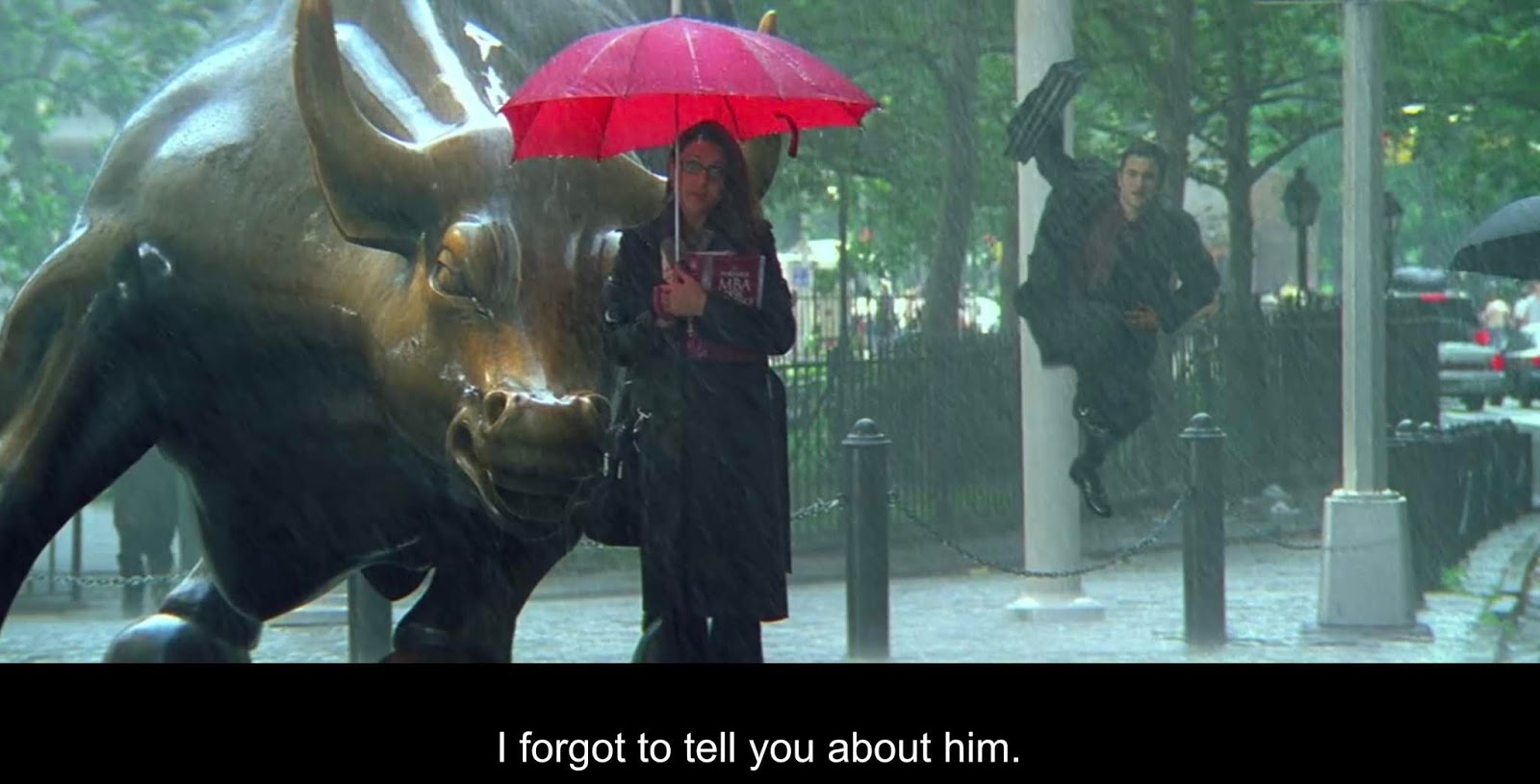
In the cinematic parlance, the phrase breaking the fourth wall is often used by writers and critics. The concept refers to the technique where the actors in a film or a play interact directly with the audience. This method was first conceptualized by Denis Diderot and the term itself was first used by Molière. The term originated in the theater where the fourth wall refers to the imaginary wall at the front of the stage that separates the audience from the performers. There are two sides and one back of the standard stage. The invisible fourth wall, thus, encloses the world created by a play. By addressing the audience directly, the actors and the performers call attention to the fact that the audience is watching the play. Thus, these moments cut through the imaginary fourth wall, hence, the term breaking the fourth wall is used to describe them.
There are many contemporary films and shows that use breaking the fourth wall as a storytelling device. Films, such as Deadpool and The Wolf of Wall Street, and shows, such as House of Cards, have used this concept recently. However, it is not really a new phenomenon. Films in Hollywood broke the fourth wall even during the early 1900s. One of the earliest examples of the technique’s use in cinema is from the 1903 film The Great Train Robbery, where a train robber shoots directly at the audience in the final scene.
Breaking the fourth wall can be done in two ways. The first option is by addressing the audience directly, or by responding to something that happens in the audience. The other way is by adding a number of metareferences, inside jokes, and social messages in films. This indirect way is also fourth-wall breaking in the sense as it is disrupting the narrative flow of the fictional world created by the film. These indirect methods are trying to tell the audience that they are watching a film and there exists a world outside the one created by the film.
In my writings on this blog, I have documented numerous instances of the indirect methods used by filmmakers to break the fourth wall. Films, such as Om Shanti Om, Johnny Gaddar, and Luck By Chance, offer a treasure trove of references and inside jokes on the world of Hindi films. I thought, therefore, to document some instances of breaking the fourth wall where the performers speak directly to the audience in the films.
One of my favorite instances of breaking the fourth wall in Hindi films is in Kal Ho Naa Ho. Different characters talk to the audience at various points in the film. Naina talks to the audience about her family and her problems. Later, the other characters also get an opportunity to speak to the audience. When Aman asks Naina the last time she smiled, all the other people tell us the last time they saw Naina smile. At a later stage, the people in the film told the audience the meaning of love. All of these moments were done in a way that felt fresh at that time and remains memorable to this day.
Films break the fourth wall in situations where characters talk about their own feelings directly to the audience circumventing the need of a narrator. In Shuddh Desi Romance, a contemporary take on live-in and marital relationships, the three lead characters break the fourth wall by explaining the thinking behind their decisions that they took in the film. The film opens with Raghu giving a spiel to the audience on the people in the society forcing lovers to get married. Later, Gayatri elaborates as to why she ran away from the altar on the day of her wedding with Raghu. In a lovely moment, Tara also talks to the audience when she breaks up with Raghu the second time. She tells us that it might be difficult to remember the moment one fell in love with but the exact moment when someone falls out of love is always remembered.
In Pyaar Ke Side Effects, a commitment-phobic DJ named Sid is unable to take the next steps in his relationship with his girlfriend Trisha. Sid often broke the fourth wall in the film and spoke directly to the audience about the side effects of love and break-up, and the events going on in his life. In Happy Ending as well, a commitment-phobic Yudi directly speaks to the audience sharing his views about the dangers of falling in love. In the anthology film Lust Stories, Anurag Kashyap's segment was about a woman named Kalindi who regularly broke the fourth wall. Much more than the film's story, it was Kalindi's monologues that made the segment watchable. She talked about love, romanticism, and selfishness by sharing her feelings with the audience. In Qarib Qarib Singlle, when Jaya signs up on the dating website Ab Tak Singlle, she breaks the fourth wall and directly speaks to the audience. At some other scenes in the film, Jaya does not speak but just looks into the camera directly to convey her feelings to the audience.
In Rules: Pyaar Ka Superhit Formula, an advertising executive Radha has a crush on Vikram. Radha's grandmother instructs her to follow a set of simple rules which will make Vikram notice her. In the film, the grandmother often breaks the fourth wall when she elaborates on her set of rules of attraction. Although she is advising Radha, she is also talking directly to the audience as if giving Dadi Maa Ke Nuskhe for the problems of love. In Sachin: A Billion Dreams, a documentary-fiction film based on the life of Sachin Tendulkar, the fourth wall is broken by the God of cricket himself where he directly addresses the audience adding emotional heft to the film.
Breaking the fourth wall has most often been used in scenarios where the characters talk to the camera and narrate the story of their past experiences or remember a special person from their life. In My Brother...Nikhil, Anamika narrates the story of her brother Nikhil who passed away after he was diagnosed with HIV. She and her family members reminisce about by Nikhil where they directly address the audience all through the film. In a similar depiction in Barfi!, a grey-haired Shruti Ghosh tells us the story of her lovable friend Barfi who was living his last days. Shruti, along with Inspector Dutta and Miss D'Souza, remember the old days when Barfi made them laugh and troubled them with his antics, but also gave them the wisdom of a lifetime. Barfi ne sikhaya tha ki khushiyan chhoti chhoti cheezo mein hoti hai, hatheli par paani mein bhi jahaaz tairte hai, ummeedein ho toh kaagaz ki chidiya ke bhi pankh hote hai. In Saawariya, Gulab Ji breaks the fourth wall when she narrates the love story of her saawariya Ranbir Raj and his Sakina. Sitting in the bar where she first met him, Gulab Ji takes us back to the days when she met this farishta in Khwaabon Ka Sheher.
Karan Johar tried breaking the fourth wall in his film Student of the Year. Based on the story of a bunch of friends reminiscing about their school days, the film shows them talking directly to the audience during the early scenes. The friends, who are preparing to visit their ailing dean, talk about their memories of the school and give a background of their relationship with the most popular students in the school. The story keeps going into flashback mode and the students break the fourth wall during the early introduction scenes.
Many films break of the fourth wall during the ending to offer some closure to the story. In Kabhi Haan Kabhi Naa, the affable don Anthony Gomes talks to the audience just when the film is about to end. He tells the viewers to not worry about his friend Sunil who was left heartbroken after the girl whom he loves marries someone else. Anthony advises the audience that life is all about acceptance and rejection, and, like Sunil, we all should move on as well. Surinder Sahni in Rab Ne Bana Di Jodi breaks the fourth wall in a delightful way during the ending of the film when he shows the audience the pictures of his honeymoon in Japan with Taani Ji. He is sharing some of the most personal moments of his life with the public without any pretense. Aditya Chopra tried breaking the fourth wall even in Dil To Pagal Hai wherein the opening credits of the films, Rahul and Nisha talk directly to the audience about their views on the existence of a soulmate.
Breaking the fourth wall has been present in some of the older films as well. In Hero Hiralal, film star Roopa is trying to get away from a crowd of people who are pestering her for an autograph. Amitabh Bachchan sees the commotion and stops his car. Roopa asks him to help her as she is trying to save the life of Hiralal. Amitabh Bachchan replies, "Aap ko bhi happy ending chahiye?" Then, he turns to the camera towards the audience and says, "Aap ko bhi?" In Ghar Ho To Aisa, Kader Khan's character Bajrangi spoke directly to the audience and refers to them as 'saamnewale' and 'his khaas public'. Whenever he spoke to the audience, he would gesture the camera to come close to him. The camera would show a close up of his face, and then, he would say his thoughts to the viewers. At one point, he even asks the audience to not leave until he tells them to go. It is hilariously done. I remember watching this film while growing up and at that time, I did not even know that there is actually a concept called breaking the fourth wall.
Film Studies Professor Ajay Gehlawat mentions an interesting observation about the song Aap Jaisa Koi from Qurbani. Although this does not involve speaking to the audience, he opines that Zeenat Aman's gaze in the song is also a form of direct address to the audience. In his research paper on the film, he writes, "In the second version of this song, which is half as long, Sheela wears a figure-hugging yellow outfit and engages in much more direct address than in the first rendition. Furthermore, while this second version also features several shots/reverse shots between Khanna and Aman, in this instance these looks–or, more precisely, Aman’s looks offscreen at Khanna–are interpellated into the direct address. Thus, at the level of gazes, one could say that while Sheela is much more the direct (private) object of Rajesh’s gaze in the first version, the second time around she is not only on display for Amar but also, via the overlapping of shot/ reverse shot and direct address, for us, the film’s external audience." By this criterion, many other songs can be categorized into the direct address.
Many a time, the characters break the fourth wall in the film trailers, while nothing of this sort happens in the film itself. As the trailer is an introduction to the film, it becomes a tool for the filmmakers to let characters talk directly to the audience on the theme of the film. In the trailer of Sanju, Ranbir Kapoor plays Sanjay Dutt where when he comes out of the jail he speaks to the audience directly. Even a film like Veer-Zaara that was released in 2004 showed something similar. In the opening trailerof the film,Saamiya Siddiqui talks to the audience while introducing herself as a lawyer fighting the case of Veer who has been wrongly jailed in Pakistan.
Breaking the fourth wall has also been observed in other films, such as Race 3, Himmatwala, Main Tera Hero, Amit Sahni Ki List, Shaitan, and Bazaar. There are many more films that have not been mentioned here. The purpose of the above was to elaborate on the technique of breaking the fourth wall and document some instances of the same. As filmmaking continues to evolve with new methods of storytelling, some filmmakers have even started talking about breaking the fifth wall and letting the audience become a part of the movies. The future of the films is indeed going to be super interesting.
Dialogue of the Day:
"Hamari filmo ki tarah, hamari zindagi mein bhi end tak sab kuch thik hi ho jaata hai."
Akarsh Khurana's Karwaan is a road-cum-coming-of-age movie set in Southern India. It is the story of Avinash (Dulquer Salmaan), who is estranged from his father. Avinash receives a call from a travel company that his father has died in an accident. When he goes to collect his father's body, he finds out that someone else's body has been exchanged with his father's. He asks his friend Shaukat (Irrfan Khan) for his van to pick up the body, but Shaukat offers to accompany him. On the way, they meet Tanya (Mithila Palkar), whose grandmother also passed away in the same accident in which Avinash's father died. All three then embark on a trip together, and as it happens in such movies, they learn some life-altering lessons that bring about a change in them.
Avinash is a repressed guy who had wanted to be a photographer but now works in a software firm because his father forced him to pick this job. He plays Solitaire in the office and eats Maggi noodles by himself. He has an obnoxious boss at work who insults people regularly. His workplace has a board on which it is written, "Don't complain. Unemployment feels a lot worse." Another one says, "Never forget you can be replaced." He seems to have made peace with his job. In this aspect, he is not different from the future Farhan Quereshi of 3 Idiots, Rahul Kapoor of Ek Main Aur Ekk Tu, or Ved Vardhan Sahni from Tamasha. Some of Avinash's scenes, such as his relationship with his father, his lost sense of identity at work, and his frustration with dealing with the demanding boss, are quite reminiscent of Ved's scenes in Tamasha. By the end of the movie, like Ved, Avinash undergoes a journey of self-enlightenment and gathers the courage to follow his passion for photography.
Karwaan's philosophy is explained by Majrooh Sultanpuri's famous couplet on Shaukat's van. It reads, "Main akela hi chala tha janib-e-manzil magar, log saath aate gaye aur karwaan banta gaya." I started all alone towards the goal; people kept joining, and it began to turn into a caravan. Something similar happens in the film as well. It starts with Avinash starting his journey to collect his father's body, and he goes to meet Shaukat. Things take a turn when they find out that the body of Avinash's father has been exchanged with someone else's, which causes them to undertake another journey. Then, they take another detour to meet Tanya. On the way, they also stop at another place to return the last remains of a woman to her family. Thus, Avinash starts alone but keeps meeting people along the way. He even runs into his ex-girlfriend from college. Log saath aate gaye aur karwaan banta gaya. And this is how life works as well. We come to this world alone and then meet people along the way. We make friends. We lose people. Many times, circumstances change, and we must take detours from our chosen path. We run into surprises. We run into old flames. We fall sick and get broken. We heal and get repaired. We constantly adapt. Our life is also a caravan perfectly encapsulated in Majrooh Sultanpuri's words. Thus, Karwaan is very much the story of life itself.
Things often come back to us somehow, as if we are part of a cosmic cycle. As Karwaan is about life itself, this cyclic aspect is seen in the film, where the protagonists are faced with situations from an earlier point in their lives that come back to them again. It brings them a new perspective, prompting them to understand other people better. Avinash thought that his father did not understand him. After meeting with Tanya, he realizes he is behaving with her just like his father used to—angry, unreasonable, and old-fashioned. He has become an old uncle who does not understand the young. In a beautiful moment, his friend Rumi tells him, "It is a never-ending cycle.Jab tak ek bete ko realize hota hai uska baap sahi tha, uska khud ka ek beta hota hai jo samajhta hai woh galat hai." By the time a son realizes that his father was right, he has a son who tells him he is wrong. Being with a young Tanya, Avinash understands his father better when he gets an opportunity to be in a situation similar to his father's. Life comes full circle for Shaukat, too. His father used to beat his mother, who accepted it as her fate. When he learns that his crush Tasneem also has to bear the abuse of her violent husband, he tells her to not repeat the mistakes of his mother. She should run away from her husband and start a new life. He is reminded of his mother when he sees Tasneem. This cyclicity is seen in the relationship between Tahira and Tanya as well. At her mother's memorial service, Tahira is giving a moving speech about her mother. She talks about how a mother learns to accept that her children grow up, become wiser, and leave. Tahira is talking about her mother, but she is also talking about herself vis-à-vis Tanya, for whom she is the mother. She ends her speech by saying that when her time comes, she hopes that her daughter will say kind words for her, like the way she said for her mother. This whole aspect of the circle of life is something that the film portrays. Children will become parents and life goes on. In the words of Rumi, it is truly a never-ending cycle.
As parents and children play a significant part in the story, it is no coincidence that all through the film, the presence of children is given a particular focus. When Avinash and Shaukat start their journey, a few children are playing near the place he stays. Later, when the three of them reach the wedding spot to give the last remains of a woman to the Nambiars, children are playing there as well. When it is the prayer service time at Tanya's house, children can again be seen playing in that house. In the end, the entire family plays cricket with the children. Parents and children are an essential part of the film's journey. At the Nambiars' house, Avinash gives money to the house help so that he can buy shoes for his daughter. The daughter of the Nambiars wants to delay her wedding because of her grieving father. At another point in Kochi, when Avinash is reading his father's letter, a father is playing with his little son. In another familial touch, director Akarsh Khurana's own father, Akash Khurana, plays the role of Avinash's father in the film, and his brother, Adhaar Khurana, plays the role of Avinash's boss.
Avinash, Shaukat, and Tanya are the unlikeliest of companions. The three of them belong to different ages and think differently about life. Yet, they develop a friendship and learn something from each other. All three of them have absent fathers in their lives. Avinash does not speak to his father because he did not let him follow the career of his choice. Shaukat keeps telling everyone that he never saw his father as he used to beat his mother, and his father never understood the meaning of the word father. Thus, he never really saw his father in the true sense. Logon ko haq jamaana aata hai, rishta nibhaana nahi. People abuse their relationships but do not care to nurture them. Tanya lost her father to cancer when she was young. Like the others, she, too, has not seen her father.
At one stage in the film, Tanya and Avinash converse about Instagram. Avinash dislikes Instagram because he feels it is ruining the science of photography and killing the joy of taking a picture. He says photography is about capturing a moment and not making a moment out of anything. Tanya replies that he is too old school and apps, such as Instagram and Snapchat, allow everyone to become a photographer. Ultimately, Avinash resigns and takes a picture of his screaming boss, which he says will go on his Instagram feed. Not only has Avinash 'found himself', but he has also embraced the idea of Instagram to move along with the times. This time, he made a moment out of anything. This is essentially what we need to do in life as well. Life is all about change, and we must adapt to the rapidly changing world, or else we will become obsolete. In the earlier scene, Avinash looks at Tanya's pictures, and he advises her that the frames of her pictures could be better and that she should focus on the subject. There were too many unnecessary elements in the frame. In some ways, he has to find the focus in his life as well and, therefore, when he has his exhibition, he calls it 'Finding Focus', a nice little touch about focusing on the things that matter in one's life.
The other thing that stands out in the film is how it treats death lightly. Though Karwaan does not have the poignancy of Mukti Bhawan, it treats death as a celebration like the latter. For a film dealing with two dead bodies, it is remarkably sanguine, with not a touch of suffocating grief that death brings with itself. Tanya and Avinash take drinking shots in the name of funerals as if they are celebrating death. As Avinash says, "Everyone has their own way of dealing with grief."
On this journey, the characters give nuggets of advice to each other that help in their enlightenment. Avinash says that one has to take responsibility for their actions. He learns that it is alright to break the rules sometimes and that one need not be repressed all the time. Tanya learns there is a difference between bagaawat (rebellion) and bevakoofi (stupidity). Shaukat gives his own pearls of wisdom in his typical deadpan style. They are funny and deep. He says, "Unhone hamein zinda dafan kar diya yeh soch ke ham mar jayenge, lekin unhe pata nahi tha hum to beej hai. Hamara dafan hona hamari viladat hai." They buried us alive to destroy us but they did not know that we are seeds. Our burial is our redemption.
My favorite bit in the film was when Avinash ran into his college girlfriend, Rumana or Rumi. It is beautiful when one unexpectedly runs into an old romantic partner. After college, Avinash disappeared without any closure, but Rumi has no hate against him. Her happiness at seeing him was more than the sadness of his leaving her. It felt like there were still some feelings between the two of them. Like the Sufi poet Rumi, she advises him to let go of his hate against his father. After meeting Rumi, Avinash goes on the journey of self-discovery (another similar touch from Tamasha that also had Rumi references). I loved that Rumi's husband, Raghu, told her he feared coming out because he thought he might not see her there. He felt vulnerable that his wife might have escaped with her old lover. Also, a very interesting take by Shalini Ji from Twitter on their relationship here is how Raghu brings home the man from his wife's past to meet and then hopes that she has not left him, opposite of what happens in Ramayana.
One discernible criticism of the film is its verbosity ruining what could have been subtle moments. For instance, after Avinash departs Rumi's house, she says he is going on a journey of self-discovery. Her husband Raghu responds that Rumi is the correct name for her and explains to us the connection between her name and the Sufi poet. Something similar again happens in the scene when Shaukat narrates the story of his abusive father, and at that moment, Tanya says that all three of them have issues with their fathers. These verbose elements ruin the impact of these beautiful scenes in the film. A film focusing on self-discovery should have the gumption to let its viewers do their own self-realization. In addition, the scenes involving Shaukat and the foreigners were jarring. It just did not go with the flow of the film. His character had a conservative outlook toward life, but these scenes did not add much to the film and were not even funny.
In terms of performances, Dulquer Salmaan and Irrfan Khan held the film while Mithila Palkar was good enough. I have seen Dulquer before in Ustad Hotel and O Kadhal Kanmani, and something is endearing about him, and he has that star quality in him. He is understated in the right amount. His real-life persona reflects on the screen. One would want him as a friend in life. Karwaan has been lovingly shot by Avinash Arun, and that shot where a Kathakali dancer smokes a cigarette is memorable.
Sometimes, I wonder how much economic liberalization has helped people to follow their dreams. Twenty-five years ago, it might be even harder for people to choose unconventional careers. It is a point that many films that advise follow-your-dreams often ignore. Here, in Karwaan, there is at least an acknowledgment that money is a factor in making some decisions, perhaps, one can rather take early retirement as Avinash's father suggests. Also, as Shah Rukh Khan once said, "Don’t philosophize until you’re rich first. I used to be poor, and I can tell you there’s nothing romantic about it. When young people, friends, say they want to be great creative novelists, I advise them to be a copywriter first, make a little money. Don’t be a struggling artist; be a happy one." With the economic growth, some people can afford to follow their dreams. Avinash's father wanted to be a piano player but could not be one, but his son was going to follow his dream.
At his father's memorial service, Avinash is finally rid of his father's spirit that was following him. He says that he does not know if his father was a good man, but he now realizes that his father was not an evil man, and these days, being not bad is also pretty great. This perfectly describes the film as well. Karwaan is not bad, and given the quality of some of the recent films, it is pretty great.
Trivia:
1. At one point, Shaukat sings the song Kitna Pyara Vada from Caravan. A reference from Caravan in Karwaan.
2. The film Ghayal is mentioned in Karwaan as well.
3. Hussain Dalal has written the dialogues of Karwaan. He has also written dialogues for films such as Yeh Jawaani Hai Deewani and 2 States. He also played the role of Naina's brother in Hichki.
4. Difference between Kannadiga and Kannada.
5. Tahira is played by Amala Akkineni, who has starred in many films with Dulquer's father, Mammootty.
6. Director Akarsh Khurana's father, Akash Khurana, plays the role of Avinash's father in the film, and his brother, Adhaar Khurana, plays the role of Avinash's boss. As mentioned here, Akash also likes to play the piano in his real life, as he says in the film.
7. Jimmy Hendrix
8. Kapil Dev
9. The full ghazal of Majrooh Sultanpuri from which the famous karwaan couplet was taken. The same couplet will also be featured in the upcoming Shah Rukh Khan film Zero.
Jab hua irfan to gham aaram-e-jaan banta gaya,
Soz-e-jaanan dil mein soz-e-digaran banta gaya,
Rafta rafta munqalib hoti gai rasm-e-chaman,
Dheere dheere naghma-e-dil bhi fughan banta gaya,
Main akela hi chala tha jaanib-e-manzil magar,
Log sath aate gae aur karwan banta gaya,
Main to jab jaanun ki bhar de saghar-e-har-khas-o-am,
This week, I am working on something else, so, just putting some random observations.
1. In Jagga Jasoos, Shruti played a twenty-five-year-old journalist and Jagga was a schoolboy. But, apparently, their passports show that Jagga was six years elder to her. And, they have the same passport number. Many other funny things in their passport are visible.
2. Two possible options mentioned for the last scene in Haider's script. None of these actually made it to the film.
3. Sonam Nair (the director of Gippi) also makes an appearance in Kapoor & Sons. She also made a cameo appearance in Wake Up Sid. Actually, her name did. Her emails can be seen in Sid's inbox. Apart from Aisha, Sid has received emails from Sonam Nair (assistant director of the film) and Panchami Ghavri (also the casting director of the film.)
4. In the recently released Thugs of Hindostan trailer, Aamir Khan's character is not only inspired by Jack Sparrow but also by the Mad Hatter, both played by Johnny Depp.
5. In Delhi-6, Rehna Tu is a love song for the city of Delhi more than anything else. I remember when the movie had released, they promoted the song to be based on Roshan and Bittoo, but it is actually a tribute to the city of Delhi. In the film, the song plays when Roshan and Ali Baig are roaming the streets of Delhi. Ali Baig also quotes the famous couplet of the poet Zauq, "Humne maana ki Dakkan mein hai bahut qadre sukhan; kaun jaaye Zauq par Dilli ki galiyan chhod kar."
One of the themes in the film was also the monkey man, so, at one point, we see a white man wearing a shirt with a monkey. I love to find these little treasures as if the director is telling us something.
6. In Kahaani, when Vidya and Rana get to know each other for the first time, he tells her his two names, the official name, and the pet name. She found that interesting as she said that one person can have two identities. It is only later we realize that she also had two identities.
7. In Band Baaja Baaraat, Shruti is often seen near mirrors.
8. I went for grocery shopping today and saw the Ragu brand of pasta sauce and was instantly reminded of the scene in Dear Zindagi where Kaira also purchased this brand that had the same name as her boyfriend. She later broke up with him and breaks a few bottles of this sauce. I thought of doing the same but stopped because khana waste karna paap hai.
More later.
Dialogue of the Day:
"You are right, Sid. Mujhe hi kuch dikhai nahi deta."
Kanwal Sethi's atmospheric Once Again is a story of two middle-aged people, Tara (Shefali Shah) and Amar (Neeraj Kabi), who fall in love once again. Tara is a businesswoman who runs a restaurant and supplies people with tiffins. Amar, a famous actor, is one of her clients. Tara and Amar develop a relationship over food and notes they exchange with the tiffins. Tara is a widow who lost her husband years ago and has two children—a son and a daughter. Amar is a divorced man and has a daughter. After the news of their relationship comes out, they face some challenges with each other and their children. The film is an Indo-German production and had a digital-only release on Netflix.
Once Again portrays an old-school romance between Amar and Tara. They have mobiles but prefer to communicate through the landlines. They can send texts to each other but prefer handwritten letters. The kitchen in Tara's restaurant consists only of traditional types of equipment. Tara uses a mortar and pestle (a silvatta) when she has to grind chillis. When she has to mix something, she uses a hand mixer. When cooking fish, she uses a furnace where she puts the raw fish wrapped in banana leaves and covers them with sand. She uses a Mangalorean-style brass tiffin box when she sends food to Amar. All these elements give a different old-school feeling to the relationship between Amar and Tara.
In addition, Amar and Tara keep talking about first times—Pehli Baar. Amar's first film that gave him his identity as a star was titled Pehli Baar, meaning the first time. After Tara meets Amar for the first time, she writes a letter to him, mentioning that in her culture, when someone visits them for the first time, it is customary to make a special dish. Later, Amar takes Tara to his favorite spot, where he tells her that it is the first time he has come with someone. When Tara takes him on a drive to the streets of Mumbai, she reminisces about the first time she came to that place as a kid. They both might be doing some things again, but it is the first time they are doing those things with each other. They fall in love once again, but it feels like it was the first time. No wonder Tara likes to sing the lovely song from Barfi!—Phir le aaya dil majboor, kya keeje. Once again, the helpless heart has brought me here.
Amar is working on a film in which he is playing the character of a ghost. It is as if elements of this ghost's story mirror those of real-life Amar's. When Tara and Amar go on a drive, he tells her that while playing the role of a ghost, he has turned into one himself. At another point, Tara thinks that she saw someone watching her, and her daughter replies that it might be a ghost. During a filmmaking session, Amar says he is unhappy with his dance performance. He feels the ghost is not dancing freely and looks like a puppet. He had seen a group of men dancing on the road during a religious procession and wanted to dance like them. The actress in his film tells him that he does not understand her role. The filmmaker adds that a ghost will turn into a human only after he falls in love, and the woman brings about the ghost's transformation. During the same scene, Tara visits Amar, and he introduces her to his friends as someone who makes food for him. He insults her by reducing her role to that of someone whose only purpose in his life is making food for him. Like Amar does not understand the woman's character in his film, he does not understand Tara's importance in real life. At an early point, Tara and Amar had a conversation where he said, "Khud ko hi dhoond ke kisi ko paya ka sakta hai." Only when you find yourself, you can find someone else. Tara replies, "Shayad kisi aur ko paakar khud ko dhoonda ja sakta hai." Maybe one can also oneself by loving someone else. It is this learning that Amar has to realize, both in his film and in his life, that only he can transform himself from a ghost to a human. When he finally understands this, Amar dances uninhibitedly with the same boys he had seen earlier during a religious celebration and turns into a human. He realizes his folly and goes to apologize to Tara. He says that he does not want to hide his own self anymore. He has understood what Tara is to him. In this sense, Amar's character is the middle-aged version of the lost protagonists created in the films of Imtiaz Ali and Ranbir Kapoor. What is a curious coincidence is that the woman who helps Amar find himself here is also named Tara (like Tara from Imtiaz Ali's Tamasha).
In some scenes of the film, there is a kind of similarity in the actions of Tara and Amar. Early in the film, Tara takes some face cream and applies it to her face while standing in front of the mirror before she goes to sleep. In the next scene, Amar is doing something similar where, after a night shoot, he sits in front of the mirror, and his make-up man cleans his face. In another scene later, it is seen that Amar washes his hands after having dinner and cleans himself. Moments later, Tara does the same after she finishes making the food, mirroring Amar's actions. Further, at another stage in the film, Tara is seen playing with a glass of water, and a few scenes later, Amar is playing with water while sitting near a swimming pool. Additionally, the film shows some similar character traits in Tara and Amar. Both Tara and Amar like ghazals. While cooking food, Tara sings a few lines from the poem Dard Se Mera Daman Bhar De by Qateel Shifai. When Amar is driving, he listens to the poem Main Khayal Hoon Kisi Aur Ka by Saleem Kausar. Tara is afraid of the sea, and Amar is afraid of the mountains.
After the death of her husband, Tara gave up everything she liked. She never married again. She runs the restaurant on her own. She never danced again. She tells her daughter that she has often thought of running away but did not do so for the sake of her children. Tara suppressed all her desires for all these years. Middle-aged people also have desires, but society believes in suppressing them. Her son's mother-in-law sarcastically remarks that, for them, the happiness of their kids is more important than their own. Tara's son did not like her mother's relationship with Amar. The daughters, on the other hand, were more open and happy for their parents. Tara was lonely. She found companionship in Amar and liked to talk to him. Being with Amar makes her feel beautiful again. After he gives her flowers in their first meeting and tells her she is beautiful, she comes to the restaurant and adjusts her hair as, perhaps after years, someone notices her. All through the film, she is often found near mirrors and looking at herself in the mirror as if wondering something. After Tara and Amar get physically intimate, she comes home and looks at her naked body in the mirror. Someone touched her after years, and that brought out her old self once again. She brings out her ghungroos. She is afraid of the sea, but in the end, she goes to the sea as she is no longer afraid of it. Like Amar, Tara undergoes a rediscovery of herself.
In terms of plot, not much happens in the film, which causes its pace to drop. Some long shots, such as characters looking out of the window or driving on the road, make the film drag at places. It is largely an atmospheric film. The other characters also are not as well developed. However, the performances of Shefali Shah and Neeraj Kabi hold the film. Shefali Shah has always been such a terrific performer, and here, as well, she is the best thing about the film. She looks lovely in the film. The sarees, the pencil in her bun, the flowers, the smile—she carries everything with a lot of elegance.
In the opening lines of the film, Amar says that Mumbai is a strange city. The sea seems so close, yet so far. Tara said she was afraid of the sea. The film ends with Amar and Tara on a boat in the sea. They have finally reached the sea that seemed distant or fearful to them. It is not clear where they are going; perhaps it is Manori. But the important thing is that they are together on this journey, much like on the journey of life itself. And, navigating the uncertain waters of the unknown future becomes less challenging with a decent companion alongside.
Trivia:
1. Tara's restaurant is named Neelam. The name of Shefali Shah's character in Dil Dhadakne Do was also Neelam.
2. The titles of Amar' Kumar's (fictional) films—Pehli Baar, Pyar Vyar, Pyaar Ka Saayaa, and Talaash.
3. Navtej Johar makes an appearance in the film.
4. Ashok, Amar's driver, is played by Bhagwan Tiwari who was also the cop in Masaan.
5. Nusrat Fateh Ali Khan's version of Kiven Mukhre
Talvin Singh's Kiven Mukhre
Dialogue of the Day:
"Shayad kisi aur ko paakar khud ko dhoonda ja sakta hai." —Tara, Once Again