Tuesday, July 4, 2017

Raincoat—Mathura Nagarpati kahe tum Gokul jao

Rituparno Ghosh's Raincoat is a beautiful film. The film is inspired by a story by O Henry called The Gift of the Magi. The story is about a married couple, Jim and Della, and how they deal with buying Christmas gifts for each other with their limited means. They both sacrifice their prized possessions to buy gifts to show how priceless their love is. Adapting to an Indian setting, Raincoat is about Mannu (Ajay Devgn) and Niru (Aishwarya Rai). They grew up in the same neighborhood and were lovers once. Due to Mannu's poor financial condition, Niru marries another guy. It is now six years later. Mannu has lost his job and needs money to start his own business. Niru, now a married woman, is dealing with financial problems as her husband suffered substantial monetary losses. She is also struggling to make ends meet. Mannu visits Niru; they reminisce about the past and make up stories about their perfect life. Like in the Gift of the Magi, a surprise gift awaits both of them. 
In one of the film's songs, Mathura Nagarpati, the lyrics ask Lord Krishna why he is returning to Gokul. Krishna was raised in Gokul by Yashodha and Nanda. He went to Mathura, where he killed his evil uncle Kansa and became the ruler of Mathura. The song talks about why he wants to leave this great kingdom and go back to Gokul to his old love. His beloved Radha is a married woman who has moved on; then, why bring back the painful memories again. Why can't he forget her and move on?
Tumhari priya ab puri gharvaali,
Doodh navan ghivoo din bhar khaali,
Biraha ke aansoon kab ke ponch daali,
Phir kaahe dard jagao,
Mathura Nagarpati kahe tum Gokul jao. 

The girl you loved (Radha) is a married woman,
Busy all day with taking out milk, cream, ghee,
She wiped away the tears of separation long back
Why do you want to evoke that pain again?
Krishna, why do you want to go to Gokul?

Although the song is ostensibly about Krishna and Radha, it mirrors the life of Mannu and Niru. Mannu and Niru are like Krishna and Radha. They were lovers once. But now a lot has changed. Niru is married to someone else and is busy with her life. At the film's beginning, Mannu's friend Alok tells him not to go to Niru's place. Alok reminds him that he took him out to watch the same movie again and again so that he could move on. Mannu's mother also tells him to not visit Niru. In the film's final moments, Alok's wife, Sheila, tells him that women are practical. She says that at that time, Niru's husband would have returned home, and she would be busy with him. Mannu believes Niru would be reminiscing about him, but it is not like that. Niru would be busy with her own issues and won't be thinking about him. Tumhari priya ab puri gharvaali, doodh navan ghivoo din bhar khaali. Yet, Mannu will take a journey to meet Niru—his Radha. Thus, we see a playing out of the song in the story of Mannu and Niru. Like the eternal love between Radha and Krishna, who could not be together but formed a lifelong bond, Niru and Mannu share the same bond. Even after years, they still love each other. There is a leitmotif of Radha-Krishna in the film's other songs.
There is a deep poignancy in Raincoat's songs that is very touching. Every song of the film is layered with melancholy and loneliness. All the songs tell their own short story within themselves. Most of the songs have been penned by the inimitable Gulzar, while a few have been written by Rituparno Ghosh himself. Shubha Mudgal has sung these beautifully. Whenever I think about Shubha Mudgal, the first thing that comes to mind is the rains. Not only because of Ab Ke Saawan, but also because her songs have a certain nostalgia that reminds us of our past, like the same feeling one gets when he is listening to music when it pours outside. It is noteworthy that the film uses a powerful voice like Shubha Mudgal's in the background score. Piya Tora Kaisa Abhimaan is lovely, but my favorite is Akele Hum Nadiya Kinare, a song filled with so much loneliness.
Maajhi tora naam to bata,
Phir kaise pukare tujhe, kaise pukare,
Akele hum nadiya kinare.
Niru left Mannu because her parents fixed her wedding with someone who could provide her security in life. Niru had not seen the man she was marrying even once before her wedding. She married her [unnamed] husband for financial security, and Mannu's financial condition was not strong enough to care for her. The film never judges Niru for her decision to marry someone rich. She did what she had to do. More often than not, humans make choices that they think are the best for them at that point. The consequences of those choices are experienced only later. As Max Baucus said, Hindsight is beautiful, but one cannot operate in hindsight. Even when Niru and Mannu lie to each other, there is never a judgment on either.

We understand their reasons for doing so and don't judge them and their actions. However, there is a point in the film where it feels that the film wanted Mannu to have shown more himmat to convince Niru. When Niru is getting married, he comes and tells her that he has arranged the car loan she wants. Niru tells him that she has known him for eight years, and he has shown his himmat only a day before her wedding. Later, the landlord tells Mannu, "Agar kaleje me itna zor nahi tha toh kahe ki mohabbat." If you did not have guts, then why get into romance? It is here that Mannu should not have given up so easily. After all, what is the point of love if you don't fight for it. 
There is an early point in the film when Mannu is crying in the bathroom. Sheila listens to his crying from the outside, and, later tells him that he should put the shower on so that no one can hear him crying. The bathroom makes an appearance a few other times in the film. On being asked why she does not travel with her husband, Niru says that she is afraid she will get locked in a bathroom on the plane and no one will help her bring her out. Mannu laughs at her. Later, this bathroom again comes back. Niru tells Mannu that she wants to leave everything and fly away somewhere. Even if she is stuck in the plane's bathroom, at least she will go somewhere with it. She is locked even today, so what if she is stuck in the bathroom. Mannu tells her that one cannot be locked in a bathroom forever; someday, someone will come and open the door for her. Thus, both of them get their own bathroom scenes. He locks himself up and cries in the bathroom; she feels trapped in her house as if she is locked in a bathroom and wants to fly away. He has not moved on from his past and is not married, still locked in the past memories, while she is locked in the burden of perpetual poverty. There is an element of entrapment and loneliness in Niru, like Charu had in Charulata. As José Arroyo writes about Charulata, "The film's windows are closed off against the heat but seem semi-barred and begin to suggest a prison. She hears a bird. She's framed by her house, sumptuous but overwhelming in its immensity: it takes her a while to get to the drawer holding her opera glasses. Finally, she peeks at the world outside, with its music and it drums, its workers. Life is available to Charu only through opera glasses and barred windows." Likewise, we feel that Niru is trapped in her house, and here too, she keeps all the windows of her home closed as if she is in prison. 
The film's title Raincoat is given as it plays an integral part in the movie. The raincoat that Mannu wore had a letter about his hardships, which Niru reads when she wears it to bring food for him. Ironically, a garment worn to hide and protect becomes the medium through which something is revealed. Hence, the title is significant. In one of the raincoat pockets, Niru puts her own jewelry so that she can help Mannu in her own way. Mannu only finds out about it later when he reaches home. This is a classic trope of surprise endings in the oeuvre of O Henry, as we saw in another recent adaptation of his story in Lootera. And, as in Lootera, there is a feeling of melancholy in the principal characters in the film. 
In the film, Mannu says that he has not come to break Niru's marriage. After this stage, we hear a lovely song in the background. The song is Meri Jaan Mujhe Jaan Na Kaho, initially sung by Geeta Dutt for the film Anubhav (1971). Directed by Basu Bhattacharya, Anubhav is the story of the relationship of Amar (Sanjeev Kumar) and Mita (Tanuja), a married couple who, after six years together, are trying to spice up their marriage. Mita is unhappy as her husband is always working. She tries to be intimate with him. However, Meeta's ex-lover, Shashi, re-enters Meeta's life and finds a job in the same organization as Amar, throwing her marriage again in jeopardy. Anubhav was the first in a trilogy of Basu Bhattacharya films based on marital relationships in contemporary urban India. In that film, there is a lovely dialogue where Amar tells Shashi, "Beeta hua kal aaj hamare beech tabhi aata hai jab hum aaj ko puri tarah jee nahi paate." The past memories come between us when we cannot fully live in the present. Rituparno Ghosh pays homage to the rain song from Anubhav, which also fits beautifully with Raincoat's own narrative. The song has beautiful lyrics by Gulzar and has many possible interpretations.
Sookhe saawan baras gaye, itni baar in aankhon se,
Do boondein na barsein, in bheegi palkon se. 
It is funny that when we meet people after a long time, we expect them to change as the general expectation is that people change with time. However, if two people had been meeting all the while, the change is not observed and the expectation of change diminishes. Niru tells Mannu that he has changed a lot in appearance and as a person. He has become darker, has lost weight, and has become quieter and more pensive. He tells her that she has not changed and is still the same as earlier. The two of them still remember many of their past memories, and they still have feelings for each other. She still feels jealous when he talks about any girl, be it his secretary or fiancée. 
Rituparno Ghosh creates some beautiful layered moments in the film that are hard to explain. When Mannu pays the rent for Niru's house, the landlord asks him that aapka prayashit hai ya prathishodh. Is it his penance or revenge? He does not answer, and he remembers when Niru was getting married, and she had told him that if they ever met again in life, she would act happy, and he won't get what she was acting. This is what she actually did when they met again. At some other point, Mannu tells Niru that since she wants a car with the same color as that of her bangles, he will fill it with roses so that the colors match. Niru advises Mannu to name his production house after her as this way, they could become life partners somehow. All through the film, the strap of Niru's bra is visible, perhaps, related to the comfort that they both had in each other's company. Niru's house is full of old antique furniture, symbolizing the past memories that they are still harboring in their hearts.
Sheila's character was also lovely. She has her own background story where she did not get to marry the person she loved. The two women in the film get married to people who are not their lovers. Perhaps, this is why Sheila is always sympathetic to Mannu, as she understands the pain of unrequited love. She is also far more practical. She might still miss her old lover in some moments, but she has moved on with grace and closed that chapter of her life. Biraha ke aansoon kab ke ponch daali. 
There are quite a few interesting references in Raincoat. In the bathroom of Alok and Shalini's house is a poster of Sophia Loren. I am not entirely sure about its context; perhaps it is some film connection that I cannot find. At different points in the film, songs from other films are used. When Niru and Mannu prepare to watch an adult film, Sau Saal Pehle starts playing. When Niru is getting married, Mere Haathon Mein starts playing. When Mannu meets Niru at her house in Bhagalpur, Jhoomka Gira Re starts playing. It is also worth mentioning that in the film's opening credits, all actors are called 'players.'
Sophia Loren
Player
Harry Potter Books
When he narrates his business plans, Mannu tells Niru that he plans to name his production house "Rajni Productions" after the old TV show Rajani. He adds that his numerologist told him to change the name as a five-letter word is unlucky. He says he is planning to write it as Rajnee. But the original TV show was called Rajani and already had six letters. Years later, this would come true in some other form when Ajay Devgan changed his name to Ajay Devgn.

Shot in a record sixteen days, Raincoat is Rituparno Ghosh's first Hindi film. Aishwarya Rai and Ajay Devgn give fabulous performances. They both look at the part and channel the pain and suffering of Niru and Mannu beautifully. They are ably supported by Mouli Ganguly and Annu Kapoor. The film's music and lyrics by Debojyoti Mishra and Gulzar add to its beauty. Over the years, the film has become a classic, and even after so many years, it does not feel dated.

Raincoat is a story of love, of the façades we wear to pretend we have moved on from that love. But in reality, there is still a lot of love left, and one can never move on completely. There is always a corner of the heart where this love stays. And, someday, a torrential downpour will bring back the memories of this love, and then, even a raincoat won't be enough, leaving us drenched in the myriad emotions of happiness and sadness.

Dialogue of the Day:
"Kisi mausam ka jhonka tha,
Jo is deewar par latki hui tasweer thirchi kar gaya hai,
Gaye sawan me ye deewarein yun seeli nahin thi, 
Na jane kyon is dafa inme seelan aa gayi hai,
Dararein par gayi hain,
Aur seelan is tarah behti hai, 
Jaise khushk rukhsaaron pe geele aansun chalte hain,
Ye baarish gungunati thi, isi chhath ki munderon par,
Ye ghar ki khidkiyon ke kaanch par ungli se likh jaati thi sandese,
Girti rehti hai baithi hui ab band roshandano ke peeche,
Dopehrein aisi lagti hain,
Bina muhron ke khaali khaane rakhein hai,
Na koi khelne waala hai baazi,
Aur na koi chaal chalta hai,
Na din hota hai ab na raat hoti hai,
Sabhi kuch ruk gaya hai,
Woh kya mausam ka jhonka tha,
Jo is deewar par latki hui tasweer thirchi kar gaya hai."
—Raincoat

Saturday, June 24, 2017

Phobia—Of Birds and Cages

Phobia, directed by Pawan Kripalani, is quite a sophisticated horror film as compared to other Hindi films in the genre. The film is the story of an artist Mehak (Radhika Apte), who after being assaulted by a taxi driver, suffers from agoraphobia—fear of open spaces. Her friend Shaan (Satyadeep Mishra) makes her move to a new apartment so that she can get treated. The apartment building is full of weird and creepy people. Mehak starts seeing an apparition, which she thinks is of Jiah, the earlier tenant who used to stay there. However, the reality is far more complicated, and nothing seems to be what is expected. 

Phobia opens with a quote by the great writer Franz Kafka—A cage went in search of a bird. The quote is from Zürau Aphorisms, a collection of aphorisms of Kafka, published by his friend Max Brod, after Kafka's death. Philosophers have interpreted the quote to be related to the themes of freedom and existentialism. In Phobia, Mehak is suffering from agoraphobia where she feels a fear of open spaces, and prefers to stay indoors. She is like a bird trapped in a cage, unable to fly out. Once she moves to the new apartment, she has become caged. Thus, Kafka's quote is befitting to some events in Mehak's life. Not only the quote, all through the film, there are bird-related symbols. At one point, we see that the tattoo on Mehak's nape is that of a bird. The door of the apartment has a statue of a black bird on it. Mehak's entire apartment is filled with decorative items with birds on them. Whether it is the paintings on the wall, or the plates in the kitchen, or the showpieces in her bedroom, everything has birds, giving a clear indication of the state of Mehak as a caged bird. At some point during the end, Shaan tells her that her fight is with herself, "Tumhari ladai khud se hai." The film, thus, is the story of Mehak where she has to fight her inner demons to get freedom from this cage. It is no coincidence that the film ends on Diwali, a festival that celebrates the victory of Ram over Ravan, the king of demons. 
Birds in Mehak's Apartment

In an unrelated context, Zoya Akhtar's Luck By Chance had a similar thing with everything in Sona Mishra's apartment related to birds as well. The shelf contained birds, pigeons, and parrots. The walls had paintings of birds. In a scene before the Baaware song, Sona and Nikki Walia are sitting together, with shiny birds in front of them. At some other point, Vikram comes to Sona's apartment and picks up a bird that had fallen off. He is also wearing a shirt with a bird on it. When Vikram meets Shah Rukh Khan later, he is again wearing a shirt with flying birds on it. Though the context in Luck By Chance is entirely different from Phobia, the underlying theme of flying away from your struggles is there in both the films. 
Birds in Luck By Chance
At some stage in the film, the psychotherapist tells Mehak, "Tumne jo kuch bhi dekha, sirf tumhara bhram hai. Tumhare andar reality aur imagination ke beech jee tod ladai chal rahi hai." Whatever she has seen, it is an illusion. There is a fight between reality and imagination in Mehak's mind. The thing to note about this conversation is that that the psychotherapist is herself using a technique related to imaginary reality—virtual reality— to treat Mehak; a method in which the person imagines that she is in a different world. It is this part for which I am struggling to come up with a rational explanation. For instance, note the scene when Mehak wears the virtual reality headset for the first time. When she is at the grocery store, the first thing we see is a poster of Spiderman. When she takes off the headset, her sister's son Joey is also wearing a Spiderman mask. When Mehak is asked to wear the headset for the second time, she visits a mall. In this second time, too, the first thing we see in the mall is a boy walking away with a Spiderman balloon. Clearly, the appearance of Spiderman in both the instances is not a coincidence. At other moments in the film, there are spiders creeping up the paintings in Mehak's apartments. When Nikki comes back from Manu's place, she says there were too many spiders under his bed. Perhaps, the film is trying to blur the boundaries between reality and imagination by using the same elements in both the cases. Someone could have a more lucid explanation but there is some implicit point that the film is trying to make by using virtual reality. Mehak does not need any virtual reality therapy because she can already experience another virtual reality in which she can see the future. 
Spiderman and Spiders
There are a lot of other details for trivia collectors in the film. The apartment where Mehak stays has the nameplate belonging to Kripalani; no surprises there as the film's director is Pavan Kripalani. The apartment building is called the Overlook Apartments, a tribute to the Overlook Hotel in Stanley Kubrick's The Shining. When Nikki comes to meet Mehak, she is wearing a shirt that has Bhoot Raja Bahar Aaja written on it. The paintings in Mehak's apartments are, actually, famous paintings. There is Christina's World by Andrew Wyeth. The opening scene of Quentin Tarantino's Inglourious Basterds was a tribute to this painting. Other notable paintings in her apartment include paintings by artists Vilhelm Hammershoi and Roy Lichtenstein. At some other point, Shaan mentions a list of notable celebrities suffering from agoraphobia, which includes people, such as Woody Allen, Sigmund Freud, and Paula Dean. He is about to mention an Indian name but we never get to hear it. I could not find any Indian celebrity suffering from agoraphobia, except possibly Parveen Babi, who locked herself in her last days; though to be fair, she was suffering from schizophrenia. Another interesting thing was the film opens with an exhibition of Mehak's paintings and there is a biography of her. In that she says, her husband asked her to try painting, though we never get to hear any background about him in the film. 
Kirpalani—Director
Bhoot Raja Bahar Aaja
Paintings by Andrew Wyeth, Vilhelm Hammershoi, and Roy Lichtenstein
Phobia has some genuine chilling moments. It combines conventional tropes of the horror genre with certain new elements, with a strong feminist subtext. It is also quite futuristic in the sense that some of the concepts in it were used later in films, such as Arrival (the ability to see the future), and House of Cards (virtual reality therapy). It deserves to be seen, if nothing, then, for the exceptional performance of its lead actress, Radhika Apte, who is brilliant in every scene. 
Other Reading:
1. The feminist subtext in Phobia—Link
2. Phobia's script for some deleted scenes—Link

Dialogue of the Day:
"Tumhare andar reality aur imagination ke beech jee tod ladai chal rahi hai. Please remember, agar tumne apne dar ko confront nahin kiya, to wo aise hi badhta jaayega."
—Dr. Khanna, Phobia

Saturday, June 10, 2017

Trapped—Survival of the Fittest

As a school-going kid, one of my nightmares was getting locked in a classroom just the day before the school closes for the two-month-long summer vacation. It is a terrifying feeling to be locked all alone in the school. I remember watching Sapnon Ka Mandir, starring Jaya Prada and Jeetendra, in which a kid gets trapped in his classroom before his vacations. The kid eats banana peels and chalk to survive. Fortunately, a blind beggar is able to save the kid in that film. There have been other brilliant human survival films. Trapped, directed by Vikramaditya Motwane, is another survival tale. It is the story of Shaurya (Rajkummar Rao), who works at a travel company in Mumbai. He likes a girl Noorie (Geetanjali Thapa) who works in his office. After a brief courtship, he asks her to move in with him to a new place. A shady property dealer tricks him into accepting an apartment on the thirty-fifth floor of an Adarsh-housing-society-scam-type building where no one else lives. Happy to find an apartment at a reasonable rent and in a short time, Shaurya shifts to the building. However, after spending his first night there, he gets trapped as the apartment door gets jammed. Murphy's law, which states that 'whatever can go wrong, will go wrong', comes into force and Shaurya cannot get out. It is ultimately left to him to devise a plan for his freedom. Rajkummar Rao as Shaurya delivers an exceptionally brilliant performance, that will be remembered for a really long time. 
At an early stage in the film, when Shaurya is moving to his new apartment, he tells his roommates that he is going home for a few days. His disinterested roommates are watching World of the Wild on a channel called Wild TV. The host of the show, a man inspired by Steve Irwin, is explaining ways to survive a difficult situation. He can be heard saying, "Never give up. Adventure is not about what happens out there. It is about what happens in here. The brave survive. The weak, they die." These lines effectively capture the film's theme and will ultimately become the motto that helps Shaurya survive his ordeal. His entrapment in the apartment is just like an adventurous encounter, as if it is another episode of Man Vs. Wild. The wilderness, though, is his own apartment which turns out to be as intimidating as a wild creation of nature. At a later stage in the film, the host again shows up in a hallucination of Shaurya. The host tells him about Charles Darwin's theory of the survival of the fittest—the principle of natural selection, postulating that those who are eliminated in the struggle for existence are the unfit. During the last few scenes, Shaurya is again watching the same TV show when he is eating paav-bhaaji. The host tells him the famous Nietzschean quote about the abyss and gives his own version of it. He says, "When you look into an abyss, the abyss also looks into you. But what I say is when the abyss looks at you funny, punch the abyss in the face." The TV host's sayings become a guiding force for survival. And, as he advised that the brave survive by never giving up, Shaurya never gave up and survived. Even the film's poster says, "Freedom lies beyond fear."
What is also noteworthy is the film's portrayal of irony. The word shaurya means courage, and ironically, the character Shaurya gets scared by hearing the squeaks of a rat. Perhaps, that is why we see a cat drawn on the door of his room. The building where Shaurya moves is named Swarg Apartments. Swarg means heaven, and ironically, his stay at the apartment will turn out to be not a heavenly experience, but something closer to hell. When Shaurya enters the apartment, there is a 'Welcome' sign written using decorative paper strips. As it turns out, this welcome would be so nightmarish that he won't even be able to get out. At a later stage, when Shaurya is hungry, he eats the remaining few pieces from the pack of biscuits he had brought along with him. We see that it is Good Day; as if there could be any other brand so befitting to ironically depict how his day was going. 
There is another moment in the film when Shaurya is lying beside a cockroach. The cockroach has turned upside down and is struggling to get back on its feet. He tries to help the cockroach, but somehow, it manages to turn itself back on its own. Shaurya keeps watching the cockroach's struggle, and then, he also decides to get up on his own feet; perhaps, getting some inspiration from it. At a later point, he sees the cockroach at the same place but it has died. It is seeing the cockroach in that state that he realizes that he, too, will die there. But he does not want to die, so, he gets pumped up to get out of the building.

Trapped also reminds us of other survivor dramas, such as 127 Hours and Life of Pi. But, somehow, the one film that kept coming to my mind was Room. Based on the novel by Emma Donoghue, Room is the story of Joy and her five-year-old son Jack who live in a shed they call the Room. Joy and Jack are captives of a man they call Old Nick, Jack's biological father, who abducted Joy seven years prior and routinely rapes her. Once a day, Joy and Jack scream as loud as they can, hoping that someone can hear them. In Trapped, Shaurya, too, tries every trick to make his voice heard, but as he says, no one can hear him, or pretends to not hear even if they can. In Room, after Joy and Jack are released, they go for a visit for one last time to the room where they had spent seven years of their life. When Shaurya manages to escape from the building, he also visits the same apartment where he was trapped. Perhaps, as a way to gain some closure or as a reminder of something that changed the course of his life forever.
Suketu Mehta, in his book Maximum City: Bombay Lost and Found, writes, "All great cities are schizophrenic said Victor Hugo. Mumbai has multiple personality disorder." There is a certain romanticism associated with the city of Mumbai, and it is often called as the city of dreams. But there is a darker underbelly associated with the city, too. Trapped shows this other side of Mumbai—harsh, uncaring, and aloof. People don't listen to you. People try to scam you. Since every inch of horizontal space has been occupied, it can only grow vertically. And, as it moves up vertically, it becomes even more and more distant. 

The scenes about the food choices and beef ban seem a little out of place in the film. It was making a political point as well given the recent news regarding bans on certain food items. The sequence where it starts rain raining, and where Shaurya talks to the rat are some of my favorite portions in the film. I was also intrigued by the relationship of Shaurya and God. Shaurya was a God-fearing person. He took the picture of Hanuman with him to his new place. He does not eat non-vegetarian food because he feels it is not right. In the end, he keeps staring at the picture of Radha-Krishna when he is about to eat paav-bhaaji. I kept thinking what was going on in his mind. Did he believe in God anymore given the ordeal he went through? He never ate non-vegetarian food and still this happened to him, so, did this change his belief in having a moral code? Or, was he just thanking God for getting out. 
Vikramaditya Motwane's earlier films—Udaan and Lootera—also exhibited the theme of entrapment, both literal and metaphorical. The word udaan, which means flight, can be described as the antonym of the word trapped. In Lootera, Pakhi thinks that her life is trapped in the last leaf of a tree as if it is a tota (parrot) from the Bheel Raja ki Kahaani that her father used to tell her. At a surface level, Trapped is about a man getting trapped in an apartment, but the film is also about other entrapments. Five minutes in the film, Noorie tells Shaurya that she is getting married to some other guy. Immediately after this, the film's title Trapped appears on a black screen as if hinting that this is the beginning of some kind of entrapment. I remember reading a piece by Priya Ramani on Tanu Weds Manu Returns where she had written about Tanu. She had explained, "When she (Tanu) leaves him (Manu), her relief is palpable. Her curly hair, tied in a bun, comes undone. The film-maker probably meant it to symbolize her return to her wild former self but as a fellow curly-haired person, I can guarantee it was as much about the respite of not being around Manu." Interestingly, we see a version of it in Trapped as well. Noorie has her hair always untied when she and Shaurya are seeing each other. However, in the last few scenes, when she comes back, her hair is tied in a bun, not only as a mark of her being married but also as another symbol of being trapped in relationships, like the film's theme. The end credits say that the property dealer's name was Hawk McNab as if this another kind of entrapment where the dealer was like a hawk waiting to trap Shaurya as his prey. 
Hawk McNab
Trapped is also about our entrapments and the loneliness of the modern day city life. We have become slaves of technology, living in our own cocoons. In the wonderful opening lines of Lage Raho Munnabhai, RJ Jhanvi summarizes it beautifully. "Internet se duniya me toh touche me hai, lekin pados me kaun rehta hai, jaante tak nahi. Agar yahi jeena hai, toh phir marna kya hai." We are trapped in relationships; trapped in the daily mundane routine; trapped in the struggle to make a living; trapped in the rules of the society; trapped in something we are not (as we saw in Tamasha). In the film's very last scene, Shaurya revisits the apartment where he had been trapped. He is looking out of the window from where he escaped and the shadow of the railings falls on his face, giving an illusion of being trapped. He goes away and the film ends with the shadows as if telling us that we may think we are free, but it is an illusion and we are still trapped in something or the other. 
Dialogue of the Day:
"When the abyss looks at you funny, punch the abyss in the face."
—Trapped

Monday, May 29, 2017

Rangoon—Of Wounds And Mirrors

Vishal Bhardwaj's Rangoon is a love story set in the 1940s against the backdrop of the Second World War. It is the story of India's top film star Julia (Kangana Ranaut), who works for the studio owner Rusi Billimoria (Saif Ali Khan). They are in love. Rusi is friends with the Britishers who want Julia to perform for the soldiers at the Indo-Burma border where the British Indian Army is fighting with the Japanese. A former prisoner of war Jamadar Nawab Malik (Shahid Kapoor) is dispatched with Julia for her safety. On the way, the Japanese attack them, and Julia and Nawab are stranded on the Burmese side. During this period, they fall in love. Eventually, they go back and have to deal with Rusi. In addition to being a love story, it is also the story of India's alternate independence movement where Nawab is on a secret mission as he works for the Indian National Army (INA) of Subhas Chandra Bose. The INA believes in violent power to achieve independence as opposed to Gandhi's non-violent approach.
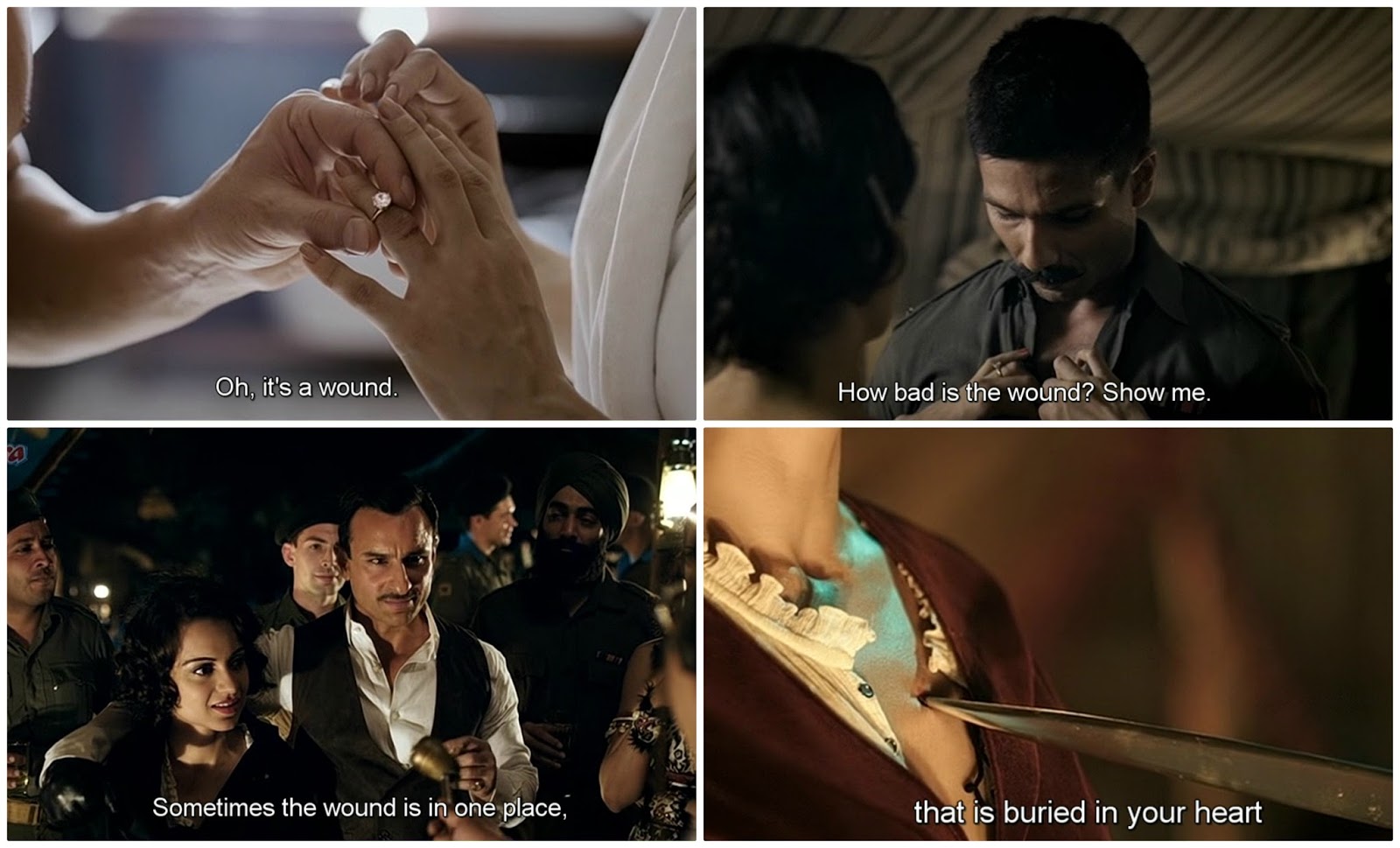
Ten minutes into the film, there is the celebration of twenty-five weeks of Julia's film Toofan Ki Beti. There is someone who is dressed as K.L. Saigal in the party and is singing Saigal's thumari Lag Gayi Chot from Yahudi Ki Ladki (1933). Lag gayi chot karejwaa mein, haye Ram—My heart is wounded, O Lord. Rangoon is set in the 1940s; thus, it refers to the music of that era. In addition, this is also one of the early references in the film about a chot, or a wound. This symbol of a wound is repeated quite a few times later as well. After Julia comes back to India from the other side, Rusi gives her a ring, but on seeing a wound on her ring finger, he says, "Zakhm hai; bhar jaaye to pehen lena." Julia replies that it will not heal anytime soon, and she forcefully wears the ring, even if it pains her because it will remind her that it is not a dream. The wound is nothing but a symbol for Nawab's love, which is not going to heal anytime soon. Later, in one of her shows, she blindfolds herself and aims to throw some knives at Nawab. One of the knives misses Nawab only by a few inches, and he is wounded on his arm. Julia realizes that she hurt him and she wanted to apologize to him for it. In another related scene, Julia and Rusi engage in a sword fight during one of her shows. Rusi figured out that she was in love with Nawab. Rusi also wounds Julia by the sword. On being asked if she was hurt, Julia replies that being wounded is a part of the game. Rusi adds, "Kabhi kabhi chot kahi lagti hai, aur zakhm kahi aur." Sometimes, the wound is in one place, and the pain at some other place, as if he was conveying that he was hurt by Julia. All the three of them talk and bear the pain of wounds—external or internal—and these wounds are a symbol for love.
There is also a contrast that the film establishes in the nature of relationships of Julia-Rusi, and Julia-Nawab. Nawab treats Julia as a woman. At one point, he calls her simply an aurat, a woman. On the other hand, Rusi calls Julia as 'Kiddo' as if she is a kid. He used to pat his thigh and asks her to come and sit on it, as if she is a small kid whom he tries to pamper. At some stage, he tells her he did not even realize that she has grown up. When Nawab and Julia are in Burma, they play in the mud [bringing back memories from that song from Khiladiyon Ka Khiladi]. Even after they are in India, Nawab and Julia often lie together in the sand, which is how Rusi gets to know about their affair—by the sand particles on their bodies. They get dirty together. In a contrast, after Julia comes back from the other side, Rusi and Julia instead of getting dirty, they clean up together. They lie in the bathtub taking a bath together. At an earlier point, Nawab sees the scar on Julia's back. He tells her it is beautiful. Just a few moments later, Rusi also looks at the scar on her back, and remarks that it is ugly. He recommends that a new cosmetic surgeon is coming to town and she should get it removed. While Nawab accepts Julia with all her scars and flaws, Rusi tries to change her into something of a more refined character. He even gave her a new name and a new identity. While Rusi uses Julia for his benefit, Nawab removes leeches from Julia's body, again a symbol of the contrast in the two relationships. 
In Bhardwaj's earlier film Haider, Gazala was represented as Kashmir. Like the two brothers India and Pakistan are fighting for Kashmir, the two brothers, Khurram and Hilaal, were fighting for Gazala. And, in this war, Kashmir's children, like Haider, are crushed. There was a deep political element in that film. All the time, I kept thinking if there is a political angle in Rangoon as well. At some point in the film, Julia's body is taken over by the leeches. Nawab removes those leeches. It was at that point, it felt like Julia was being compared to India. Julia, struggling to find her own identity and independence, was being used by Rusi's company; much like India, plundered by the Britishers like leeches for their gain. Julia is conflicted by the two sides—Rusi and Nawab; like India has to decide the path to follow—the non-violence of Gandhi, or the armed struggle of Subhas Chandra Bose. Earlier, Julia used to apply fairness creams, which is why Nawab said that India is a slave of white people, again, a subtle hint of comparing Julia to India. 
There are a few other touches from Haider as well. At some point in Haider, Gazala walks into her old house that was destroyed by the Indian Army to meet her son. When she enters the house, there is a broken mirror on the wall, and in that broken mirror, we see two faces of her. On seeing her, Haider remarks, "Do chehre hain aapke." There is a similar scene in Rangoon when Julia, Nawab and the Japanese soldier find a church. We see Julia in the broken mirror in the church. In fact, all throughout the film, Julia is found near the mirrors. In her first scene in the film, she is seen in front of a mirror. Later, in many a scene, she is often found near a mirror. Perhaps, it was again a symbol of her trying to find her own identity. As at some later point, she says to Rusi, sometimes, she is Miss Julia, sometimes she is Mrs. Billimoria; he calls her whatever she wants. At some stage, she looks at Nawab through the mirror and realizes that she hurt his left arm; but he tells her that it was the right arm, which is a sign of the film's intelligence that it thought about this subtle difference. There is also the signature scene that is present in almost all of Vishal Bhardwaj's films where the lovers are seen together in the mirror. Here, in Rangoon, too, a similar shot is present. It is fascinating to note these touches that the filmmakers try to bring in all their films. 

Mirrors in Vishal Bhardwaj's Films
Julia's character is ostensibly inspired from Fearless Nadia, one of the earliest female-leads in Indian films. The film opens with the people, who play an important part in the making of a film, singing about the star Julia. It is noteworthy that all of them are men. They are shooting the film Toofan Ki Beti. A few moments later, Julia appears. She performs some stunts and helps rescue another woman character, like a hero. Later, one of the commentators, actually, calls her the hero of the film. During the second half, she performs some real stunts from a train; the same song Julia again plays but this time, she saves a man, Nawab, from the English forces. This is not a part of any of her films, but she does it for someone important in her life. She has become the savior. Later, she tells Nawab that she will join the Jhansi Ki Rani Regiment (which coincidentally is also one of Kangana's upcoming films; talk about art imitating life). In an old piece in The Caravan magazine, Baradwaj Rangan had written on the female characters in Vishal Bhardwaj's films. He had written, "Vishal Bhardwaj's ultra-strong female characters are united by loss, manipulation and a haunting trace of vulnerability." The same description could, in some ways, aptly describe Julia, too. But the difference is Julia's character arc progresses through these different characteristics. From silently acquiescing to the British rule to rebelling against them; from being called as Rusi's parrot to calling herself God who can do anything; from a vulnerable kiddo to a strong woman, Julia comes on her own in the film. 
The conversations between Julia and the Japanese soldier Hiromichi are quite reminiscent of the conversation between Rani and Taka in Queen. They both are talking to each other about different things but it feels that they are talking about the same thing. For trivia buffs, another connection can be made between the two films. The terrific song Tippa is a rehashed version of Tup Tup Topi Topi of Alice In Wonderland that used to come on DD National in the nineties. Both the songs are written by Gulzar and have music by Vishal Bhardwaj. In Queen, too, there is Alice In Wonderland. At some point in the film, when Rani is in the hostel in Amsterdam, she is wearing a sweatshirt on which is written 'Alice in Wonderland meets the White Rabbit', as if telling us that Rani was also like Alice, who has fallen into the wonderland and is fascinated by the creatures she meets. 


Rusi lost his hand when he was performing a stunt on a train. His grandfather tells him that he should have stopped him from doing so. He had lied about his health to stop Rusi from going with Julia. He says that Rusi has become a romantic hero from an action hero. At an earlier point in the film, there is a poster of Rusi in his film called Maut Ka Rassa in which he is trying to balance himself on a rope. In what could be his return to action, during the last scene of the film he is walking on the same Maut Ka Rassa as if it was his own redemption as well. It was interesting to note his love for heights in initial portions of the film. Note the position from where he sees Julia's stunts during Toofan Ki Beti, and later, when he introduces Major Harding from a bizarre position where everyone had to look many floors above to see them. 
"Hua hai Shah ka musaahib, fir hai itarata, warna shehar mein Ghalib ki aabroo kya hai", says Major General David Harding when he first appears on the screen. He loves to quote Ghalib. He knows how to speak Hindi, and can speak better Urdu that even Indians need help to understand. Julia had to ask him what does unwan mean when he asked her the unwan (title) of her next film. He plays the harmonium and sings Ka Karun Sajni Aaye Na Baalam. He mouths funny lines, such as "I am white, white is always right." At some later point, he jokes that if the Britishers ever leave India, it will become one of the most corrupt societies in the world, which sadly is true. Despite all these quirks, his character does not become as menacing as his role demanded. It felt more of a caricature.

Since the film is set in the early 1940s, there are other references to that era. When Rusi tells Julia she will not work after their wedding, she tells him that Himanshu also let Devika work. Himanshu was one of the founders of Bombay Talkies studio, and Devika is widely believed to be the first lady of Indian cinema. At some places in the film, there are film posters of that time, such as Pukar (1939) and King Kong (1933). There is a hat tip to All the world's a stage line by Bhardwaj's favorite Shakespeare. It is also noteworthy that there is a song Mere Piya Gaye Rangoon from Patanga (1949), and in this film, there is a song Mere Miya Gaye England, as if making some point with the expectations of the listener.
 King Kong
Pukar
At the heart of it, Rangoon is about loyalty—loyalty to the cause. Is there anything more precious than your life? Yes, something for which you can die for. This is the premise of Rangoon. There is a lovely moment in the song Yeh Ishq Hai where Nawab collects the melted wax from the candle. Like a candle burns itself to death for giving light to others, his own cause is worth dying for him. As the lyrics say, "Jalte hi rehna hai, baaki na main na tu." Nawab knew he is not going to survive after the Britishers capture him, so, he got himself killed. I was a little irritated by Julia coming back to the bridge when it is obvious that Nawab is going to get killed. Does not she know that they killed Zulfi and Mema in front of her own eyes when they told her they won't? But I guess for her, something she could die for was Nawab, and as she said to Rusi, she already died with Nawab. 
The time when Julia, Nawab, and Hiromichi are traversing through the wilderness of Burma forms some of the most beautiful moments in the film. Hiromichi tells his background story, where he wanted to become a singer, but due to war, he had to join the army. He graduated from the music school. He wants to eat his favorite dish prepared by his mother, and he wants to go home. He plays the mouth organ and Julia sings Tippa, and we realize the futility of war in dividing us and the power of music in uniting us. When Hiromichi is about to escape, he does not want to shoot Nawab and Julia, but he said a Japanese soldier cannot go back in defeat as no one will understand. Nawab says to go because his mother will understand. As Washington Irving once wrote, "There is an endearing tenderness in the love of a mother to a son that transcends all other affections of the heart." At that point, Hiromichi bows down in front of Nawab, and then, leaves. Sometimes, a small moment as this becomes the most powerful moment of it all.  
Other Reading:
1. On Haider—Link
2. On Detective Byomkesh Bakshi—Link
3. Baradjwaj Rangan on female characters—Link
4. Amitav Ghosh's Ibis Trilogy books for opium wars

Dialogue of the Day
"Vo aatish hai jo aashiq hai."
—Rusi, Rangoon

"Mohabbat jaan boojh ke toh nahi ki jaati. Bas ho gayi."
—Rusi, Rangoon

Friday, May 19, 2017

Happy Thirtieth, P :)

Happy Thirtieth Birthday, P. Every year I write a post on my birthday, but it is a significant milestone this year. Thirty years is big. Day by day, nothing changes, but if we look at the period, a lot changes. If I look back at the time between when I was twenty and now when I am thirty, so much has changed, professionally and personally. I don't know where to even begin. People have left me; I have left people. But the one thing that has stayed with me is this blog. It is ten years of blogging. I started this blog in 2007; it is now ten years old. Initially, it was my medium for writing [pretentious] simplistic posts on complex social issues. It became an outlet channel for the emotional turmoil of the twenties, and finally, it focused only on the one thing I genuinely love—movies. The blog reminds me of my [limited] maturity and growth. The movies have helped me make the most friends through this blog: people from places I have never been, and most likely will never be. I struggle to make and maintain friendships, given that I have so few real-life friends, but I feel humbled to know people through this blog. I am always surprised by the emotional depth people see in the movies, and I have learned so much from them. People are just amazing, and it is fascinating that each has their own view of how a movie touched them. Given the work schedule, I hope to continue writing, though it is becoming increasingly difficult for me. I also have to think of taking this to the next step. Let's see how it turns out. I have to set a few goals for the next decade so that when I look back at this post when I am forty (and if I am alive at that time), I can see if I have achieved what I had planned for. Thank you to everyone who sent me their wishes today. I am so truly touched and moved by the messages that everyone sent. S wrote a special post on his blog for me (link). I am not worthy of it, but I felt special when I read it. And, yes, I took a trip to Los Angeles for my birthday because, as I always say, we must find our own happiness. If we don't, no one will. Today, I visited where La La Land was shot. Some pictures are below. More later :)
 
 
Dialogue of the Day:
"Mera sense of humour bahot accha hai, aapko dheere dheere pata chalega."
—Rani, Queen

Sunday, May 14, 2017

Zoya Akhtar, Dreams, and Khwabon Ke Parindey

At some point in Damien Chazelle's La La Land, Sebastian Wilder (Ryan Gosling) and Mia Dolan (Emma Stone) are having a conversation over dinner. Sebastian, a pianist, joined a band to have a steady source of income, though he does not like the kind of music he plays. His dream is to open a jazz club of his own. Mia asks him till when will he be on the musical tour as she thinks he is doing it only for a short term; however, Sebastian replies that he plans to be there for at least two years, perhaps, even more. Mia is taken aback by the revelation that Sebastian is giving up on his dream. She tells him, "I am pointing out that you had a dream, that you followed, that you were sticking to." Sebastian says, "It is just time to grow up. This is the dream, this is the dream. Guys like me work their whole life to be in something that is successful, that people like." Later, Mia sings about dreamers in her audition, "Here's to the ones who dream, foolish as they may seem. Here's to the hearts that ache, here's to the mess we make." The much-loved film tells the story of two dreamers. All the time while watching La La Land, I was constantly reminded of Zoya Akhtar's exceptionally brilliant Luck By Chance, which in many ways, is quite similar to La La Land. 
Luck By Chance is also about dreamers. In fact, the realization dawned on me that all the four films of Zoya Akhtar have a theme of dreams in them. Her oeuvre emphasizes that people should follow their dreams. Zoya's first film Luck By Chance is about Vikram Jaisingh (Farhan Akhtar) and Sona Mishra (Konkona Sen Sharma). The two of them have come to Mumbai to become actors. The film depicts their struggle, their challenges, and the role of luck and destiny in their lives. Both Vikram and Sona dream to become successful actors; they make compromises along the way, and display a benign ruthlessness in manipulating people, especially Vikram, to get their dream fulfilled. Sona has run away from her home, and Vikram does not want to join his father's business, as they want to become actors. In an early point in the film, Aamir Khan makes an appearance as himself, shooting for a film where he plays a character in a period film set in Mumbai. The character that he plays is Anand Babu and he says, "Sapne toh sabhi dekhte hai, lekin sirf wohi sapna saakar hota hai, jo laakh samjhaane par bhi insaan bhulana nahi chahta." Everyone dreams but only that dream gets fulfilled which a person does not want to forget, in spite of being told to forget it. This, essentially, becomes the motto for Vikram. When Satish Chaudhry refuses to give a role to Sona for his film, she is heartbroken, and Vikram consoles her by saying to never give up. One should keep walking on her chosen path, and eventually, the world will join her in her journey. This theme of dreams again comes up when Vikram goes for his audition at Romy Rolly Productions, and the song Sapnon Se Bhare Naina plays. The lyrics talk about a child chasing a butterfly, and all that one wants to find is to be found inside. It talks about those who dream. Sapnon se bhare naina, na neend hai na chaina. When there are dreams in your eyes, there is neither sleep nor peace. The song is picturized in a room full of men who are auditioning to become actors. There is someone in the room who does not have any money to buy even a new pair of shoes. He does not know English, and is a little embarrassed to ask for Vikram's help in filling the form. All he wants is to become an actor; his audition was perhaps among the best as well, but he most likely lost out due to his looks. These strugglers, despite knowing the harsh reality of being an outsider in an industry that does not treat them well, still dream to get something they want. During the final scenes, the film also acknowledges Amitabh Bachchan and Shah Rukh Khan, two outsiders, who never gave up on their dreams and made it big in the industry.
In Zoya's second film Zindagi Na Milegi Dobra, there are three friends—Arjun (Hrithik Roshan), Imran (Farhan Akhtar), and Kabir (Abhay Deol). The friends go on a road trip in Spain as they had made a pact years ago. During the trip, each of them chooses an adventure sport that they will have to do. Arjun is a workaholic investment banker. He is so busy working that he has no time for his personal life. In Spain, he meets the diving instructor Laila (Katrina Kaif) who helps him understand the way to live. Arjun thinks he will make enough money by working till he is forty years and then do things that he really likes, such as cooking. Laila, like Professor John Keating from Dead Poets Society, tells him, "Seize the day," and live each day to the fullest before making plans for the future. He falls in love with her, and here also, we see an aspect related to dreams. The song Khwabon Ke Parindey plays that describes Arjun's state of mind and talks about his dreams flying like the birds. He is feeling relaxed. He is basking in the sunshine. He is taking more space in the car by lying down. He makes hand gestures of going with the flow, which is quite a contrast with his methodical packing in the film's opening credits. 
Udein, khule aasaman mein khwabon ke parindey,
Udein, dil ke jahaan main khaabon ke parinday,
Ohho, kya pata, jaayenge kahaan,
Khule hain jo par, kahe yeh nazar,
Lagta hai ab hain jaage hum,
Fikrein jo thi, peechhe reh gayi.
At some other point in the film, Kabir asks his fiancée Natasha that why does she plan to quit her job after their wedding. It was her dream and she should continue to work on that. Natasha replies that dreams change and priorities change. This scene has stuck with me, where I have often wondered if dreams change. As Sebastian says in La La Land, perhaps, we grow up and we want different things at different points in life. In the film's end credits, Sooraj Ki Baahon Mein plays, where again this dream theme comes up. Naye naye sapne jo bunn sake, usi zindagi ko kaho zindagi. In which I can weave new dreams, I’ll only call that life, a real one. 
In Bombay Talkies, Zoya directed the segment called Sheila Ki Jawaani. The story is about a child Vicky (Naman Jain) who wants to become a dancer when he grows up. His strict father does not approve his son embracing his feminine side. His father enrolls him in a football coaching class, but Vicky struggles to get even the smallest basics of football correct. His family goes to watch Tees Maar Khan, and when the song Shiela Ki Jawaani plays on the screen, Vicky is thrilled. It was as if he finally found that he wants to be. At a later point, Vicky watches a TV show where Katrina Kaif is being interviewed. On being asked her reason for success, she says she just followed her dream. At that instant, Vicky imagines that she is a fairy, who is talking to him directly. She is his Manic Pixie Dream Girl. Katrina tells him that it is important to preserve one's dreams and for that he might even have to lie. She says to Vicky, "Kabhi kabhi apne dream ko chhupana padta hai. People always don’t understand you, so they will discourage you. Lekin tumhe to pata hai na, tumhara sapna kya hai, toh uska khayal bhi tumhe rakhna padega. You have to nurture it. You have to protect it aur vaise bhi zaroorai nahi hai ki har baat, har waqt doosron ko batayi jayi. Har baat batane ka ek sahi waqt hota hai. Jaante ho tum jo chaho kar sakte ho, jo chaho ban sakte ho. Follow your heart for there is magic in your dreams. If you believe them, they will come true. Bas yakeen karo ki aisa hoga aur tumhe koi nahi rok sakta." Here, also, there is the theme of dreams. Katrina becomes a guardian angel for Vicky. She provides the anchor to the boat of Vicky's dreams. Katrina was like Laila from Zindagi Na Milegi Dobara, advising Vicky like Laila taught Arjun the meaning of life. 
Dil Dhadakne Do tells the story of the dysfunctional Mehra family. Neelam Mehra (Shefali Shah) is a homemaker married to Kamal Mehra (Anil Kapoor), a self-made businessman. They have two children—Ayesha and Kabir. Ayesha (Priyanka Chopra) runs her own company and Kabir (Ranveer Singh) works with his father in their family business. Kabir dreams of becoming a pilot; however, his family wants him to run their firm. He does not fully get business, and feels that he does not belong there. On a cruise, he meets Farah (Anushka Sharma). Farah is a dancer. Like Sona from Luck By Chance, Farah ran away from her home because her conservative family did not want her to become a dancer. But it was her dream to be one, so, she left them. Kabir is taken aback by the fearlessness of Farah to follow her dreams. He never thought of rebelling, but only after meeting Farah, he gets the courage to talk to his parents that he wants to do something in the field of flying. In addition, there is a line in the film's title song, "Hum toh yehi samjhayenge usey, sapne jo hai sajaane thode se bano diwaane." We’ll only say to him, that if you want to fulfill your dreams, be a bit crazy. 
Thus, there is a theme related to dreams in all her films. In some earlier posts, I had written on the motif of flowers in the films of Zoya Akhtar. Almost every scene in Luck By Chance had a flower, and this flower pattern was seen in Bombay Talkies and Dil Dhadakne Do, too. There is also a theme of liberation and repression in her films. Interestingly, her next directorial venture is Gully Boy, which seems to be based on the lives of street rappers from Mumbai's chawls and ghettos. Given the subject matter, it is very likely that even Gully Boy will have a theme related to dreams as well. 

Other Reading:
1. On Luck By Chance—Link and Link
2. On Dil Dhadakne Do—Link
3. On Bombay Talkies—Link

Dialogue of the Day

"Agar Shah Jahan practical hota to phir Taj Mahal kaun banata."
—Kabir, Dil Dhadakne Do

Monday, May 8, 2017

Postcard

I have been a bit preoccupied with work. Not getting time to write. Two drafts lying. Hoping to get some time soon :(

Restarting the postcard thread. If you would like a postcard from me, please fill in your name and address at this link. Of course, if you can trust a stranger with an address, else don't fill in.