Monday, May 29, 2017

Rangoon—Of Wounds And Mirrors

Vishal Bhardwaj's Rangoon is a love story set in the 1940s against the backdrop of the Second World War. It is the story of India's top film star Julia (Kangana Ranaut), who works for the studio owner Rusi Billimoria (Saif Ali Khan). They are in love. Rusi is friends with the Britishers who want Julia to perform for the soldiers at the Indo-Burma border where the British Indian Army is fighting with the Japanese. A former prisoner of war Jamadar Nawab Malik (Shahid Kapoor) is dispatched with Julia for her safety. On the way, the Japanese attack them, and Julia and Nawab are stranded on the Burmese side. During this period, they fall in love. Eventually, they go back and have to deal with Rusi. In addition to being a love story, it is also the story of India's alternate independence movement where Nawab is on a secret mission as he works for the Indian National Army (INA) of Subhas Chandra Bose. The INA believes in violent power to achieve independence as opposed to Gandhi's non-violent approach.
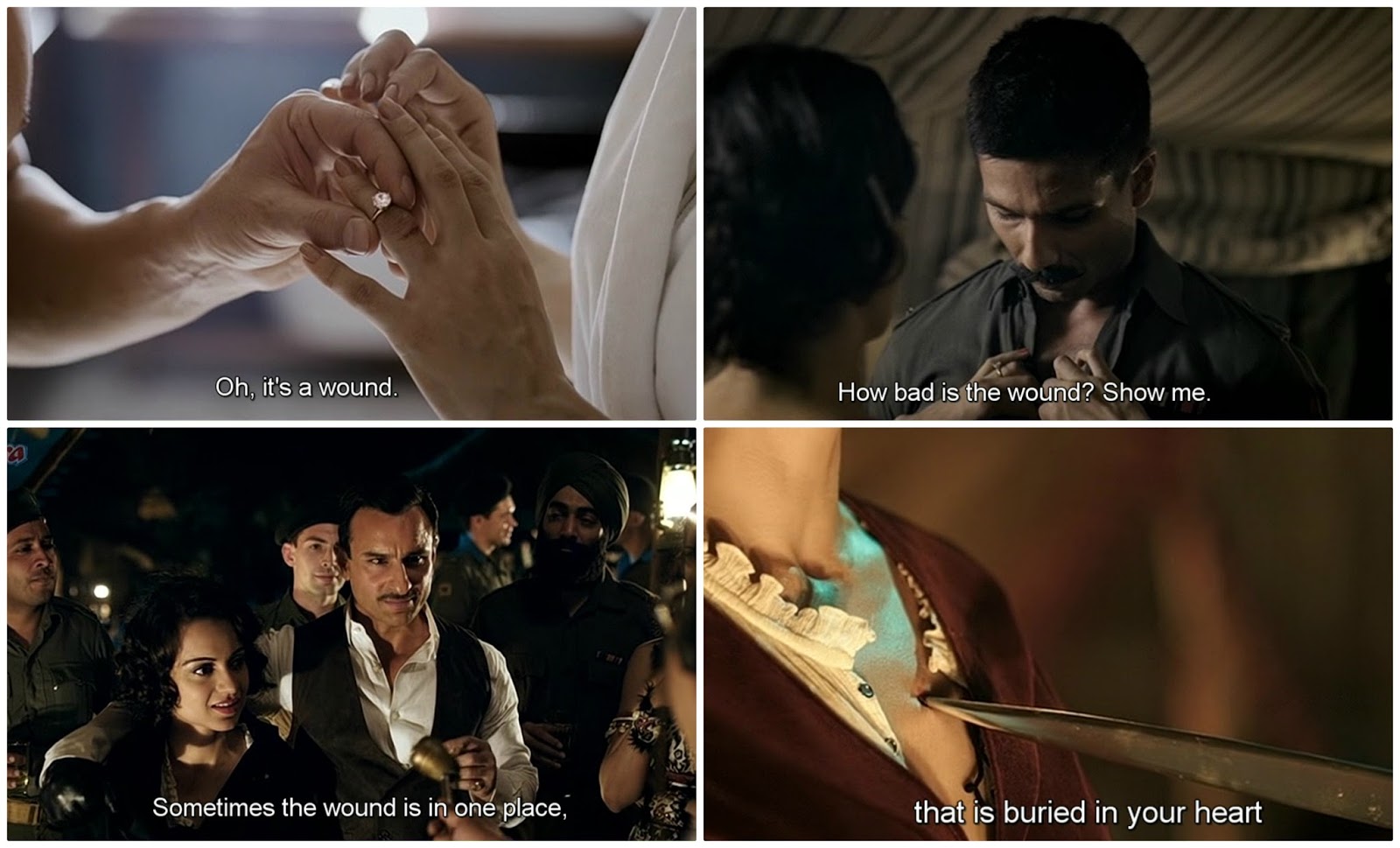
Ten minutes into the film, there is the celebration of twenty-five weeks of Julia's film Toofan Ki Beti. There is someone who is dressed as K.L. Saigal in the party and is singing Saigal's thumari Lag Gayi Chot from Yahudi Ki Ladki (1933). Lag gayi chot karejwaa mein, haye RamMy heart is wounded, O Lord. Rangoon is set in the 1940s; thus, it refers to the music of that era. In addition, this is also one of the early references in the film about a chot, or a wound. This symbol of a wound is repeated quite a few times later as well. After Julia comes back to India from the other side, Rusi gives her a ring, but on seeing a wound on her ring finger, he says, "Zakhm hai; bhar jaaye to pehen lena." Julia replies that it will not heal anytime soon, and she forcefully wears the ring, even if it pains her because it will remind her that it is not a dream. The wound is nothing but a symbol for Nawab's love, which is not going to heal anytime soon. Later, in one of her shows, she blindfolds herself and aims to throw some knives at Nawab. One of the knives misses Nawab only by a few inches, and he is wounded on his arm. Julia realizes that she hurt him and she wanted to apologize to him for it. In another related scene, Julia and Rusi engage in a sword fight during one of her shows. Rusi figured out that she was in love with Nawab. Rusi also wounds Julia by the sword. On being asked if she was hurt, Julia replies that being wounded is a part of the game. Rusi adds, "Kabhi kabhi chot kahi lagti hai, aur zakhm kahi aur." Sometimes, the wound is in one place, and the pain at some other place, as if he was conveying that he was hurt by Julia. All the three of them talk and bear the pain of wounds—external or internal—and these wounds are a symbol for love.
There is also a contrast that the film establishes in the nature of relationships of Julia-Rusi, and Julia-Nawab. Nawab treats Julia as a woman. At one point, he calls her simply an aurat, a woman. On the other hand, Rusi calls Julia as 'Kiddo' as if she is a kid. He used to pat his thigh and asks her to come and sit on it, as if she is a small kid whom he tries to pamper. At some stage, he tells her he did not even realize that she has grown up. When Nawab and Julia are in Burma, they play in the mud [bringing back memories from that song from Khiladiyon Ka Khiladi]. Even after they are in India, Nawab and Julia often lie together in the sand, which is how Rusi gets to know about their affairby the sand particles on their bodies. They get dirty together. In a contrast, after Julia comes back from the other side, Rusi and Julia instead of getting dirty, they clean up together. They lie in the bathtub taking a bath together. At an earlier point, Nawab sees the scar on Julia's back. He tells her it is beautiful. Just a few moments later, Rusi also looks at the scar on her back, and remarks that it is ugly. He recommends that a new cosmetic surgeon is coming to town and she should get it removed. While Nawab accepts Julia with all her scars and flaws, Rusi tries to change her into something of a more refined character. He even gave her a new name and a new identity. While Rusi uses Julia for his benefit, Nawab removes leeches from Julia's body, again a symbol of the contrast in the two relationships. 
In Bhardwaj's earlier film Haider, Gazala was represented as Kashmir. Like the two brothers India and Pakistan are fighting for Kashmir, the two brothers, Khurram and Hilaal, were fighting for Gazala. And, in this war, Kashmir's children, like Haider, are crushed. There was a deep political element in that film. All the time, I kept thinking if there is a political angle in Rangoon as well. At some point in the film, Julia's body is taken over by the leeches. Nawab removes those leeches. It was at that point, it felt like Julia was being compared to India. Julia, struggling to find her own identity and independence, was being used by Rusi's company; much like India, plundered by the Britishers like leeches for their gain. Julia is conflicted by the two sides—Rusi and Nawab; like India has to decide the path to follow—the non-violence of Gandhi, or the armed struggle of Subhas Chandra Bose. Earlier, Julia used to apply fairness creams, which is why Nawab said that India is a slave of white people, again, a subtle hint of comparing Julia to India. 
There are a few other touches from Haider as well. At some point in HaiderGazala walks into her old house that was destroyed by the Indian Army to meet her son. When she enters the house, there is a broken mirror on the wall, and in that broken mirror, we see two faces of her. On seeing her, Haider remarks, "Do chehre hain aapke." There is a similar scene in Rangoon when Julia, Nawab and the Japanese soldier find a church. We see Julia in the broken mirror in the church. In fact, all throughout the film, Julia is found near the mirrors. In her first scene in the film, she is seen in front of a mirror. Later, in many a scene, she is often found near a mirror. Perhaps, it was again a symbol of her trying to find her own identity. As at some later point, she says to Rusi, sometimes, she is Miss Julia, sometimes she is Mrs. Billimoria; he calls her whatever she wants. At some stage, she looks at Nawab through the mirror and realizes that she hurt his left arm; but he tells her that it was the right arm, which is a sign of the film's intelligence that it thought about this subtle difference. There is also the signature scene that is present in almost all of Vishal Bhardwaj's films where the lovers are seen together in the mirror. Here, in Rangoon, too, a similar shot is present. It is fascinating to note these touches that the filmmakers try to bring in all their films. 

Mirrors in Vishal Bhardwaj's Films
Julia's character is ostensibly inspired from Fearless Nadia, one of the earliest female-leads in Indian films. The film opens with the people, who play an important part in the making of a film, singing about the star Julia. It is noteworthy that all of them are men. They are shooting the film Toofan Ki Beti. A few moments later, Julia appears. She performs some stunts and helps rescue another woman character, like a hero. Later, one of the commentators, actually, calls her the hero of the film. During the second half, she performs some real stunts from a train; the same song Julia again plays but this time, she saves a man, Nawab, from the English forces. This is not a part of any of her films, but she does it for someone important in her life. She has become the savior. Later, she tells Nawab that she will join the Jhansi Ki Rani Regiment (which coincidentally is also one of Kangana's upcoming films; talk about art imitating life). In an old piece in The Caravan magazine, Baradwaj Rangan had written on the female characters in Vishal Bhardwaj's films. He had written, "Vishal Bhardwaj's ultra-strong female characters are united by loss, manipulation and a haunting trace of vulnerability." The same description could, in some ways, aptly describe Julia, too. But the difference is Julia's character arc progresses through these different characteristics. From silently acquiescing to the British rule to rebelling against them; from being called as Rusi's parrot to calling herself God who can do anything; from a vulnerable kiddo to a strong woman, Julia comes on her own in the film. 
The conversations between Julia and the Japanese soldier Hiromichi are quite reminiscent of the conversation between Rani and Taka in Queen. They both are talking to each other about different things but it feels that they are talking about the same thing. For trivia buffs, another connection can be made between the two films. The terrific song Tippa is a rehashed version of Tup Tup Topi Topi of Alice In Wonderland that used to come on DD National in the nineties. Both the songs are written by Gulzar and have music by Vishal Bhardwaj. In Queen, too, there is Alice In Wonderland. At some point in the film, when Rani is in the hostel in Amsterdam, she is wearing a sweatshirt on which is written 'Alice in Wonderland meets the White Rabbit', as if telling us that Rani was also like Alice, who has fallen into the wonderland and is fascinated by the creatures she meets. 


Rusi lost his hand when he was performing a stunt on a train. His grandfather tells him that he should have stopped him from doing so. He had lied about his health to stop Rusi from going with Julia. He says that Rusi has become a romantic hero from an action hero. At an earlier point in the film, there is a poster of Rusi in his film called Maut Ka Rassa in which he is trying to balance himself on a rope. In what could be his return to action, during the last scene of the film he is walking on the same Maut Ka Rassa as if it was his own redemption as well. It was interesting to note his love for heights in initial portions of the film. Note the position from where he sees Julia's stunts during Toofan Ki Beti, and later, when he introduces Major Harding from a bizarre position where everyone had to look many floors above to see them. 
"Hua hai Shah ka musaahib, fir hai itarata, warna shehar mein Ghalib ki aabroo kya hai", says Major General David Harding when he first appears on the screen. He loves to quote Ghalib. He knows how to speak Hindi, and can speak better Urdu that even Indians need help to understand. Julia had to ask him what does unwan mean when he asked her the unwan (title) of her next film. He plays the harmonium and sings Ka Karun Sajni Aaye Na Baalam. He mouths funny lines, such as "I am white, white is always right." At some later point, he jokes that if the Britishers ever leave India, it will become one of the most corrupt societies in the world, which sadly is true. Despite all these quirks, his character does not become as menacing as his role demanded. It felt more of a caricature.

Since the film is set in the early 1940s, there are other references to that era. When Rusi tells Julia she will not work after their wedding, she tells him that Himanshu also let Devika work. Himanshu was one of the founders of Bombay Talkies studio, and Devika is widely believed to be the first lady of Indian cinema. At some places in the film, there are film posters of that time, such as Pukar (1939) and King Kong (1933). There is a hat tip to All the world's a stage line by Bhardwaj's favorite Shakespeare. It is also noteworthy that there is a song Mere Piya Gaye Rangoon from Patanga (1949), and in this film, there is a song Mere Miya Gaye England, as if making some point with the expectations of the listener.
 King Kong
Pukar
At the heart of it, Rangoon is about loyalty—loyalty to the cause. Is there anything more precious than your life? Yes, something for which you can die for. This is the premise of Rangoon. There is a lovely moment in the song Yeh Ishq Hai where Nawab collects the melted wax from the candle. Like a candle burns itself to death for giving light to others, his own cause is worth dying for him. As the lyrics say, "Jalte hi rehna hai, baaki na main na tu." Nawab knew he is not going to survive after the Britishers capture him, so, he got himself killed. I was a little irritated by Julia coming back to the bridge when it is obvious that Nawab is going to get killed. Does not she know that they killed Zulfi and Mema in front of her own eyes when they told her they won't? But I guess for her, something she could die for was Nawab, and as she said to Rusi, she already died with Nawab. 
The time when Julia, Nawab, and Hiromichi are traversing through the wilderness of Burma forms some of the most beautiful moments in the film. Hiromichi tells his background story, where he wanted to become a singer, but due to war, he had to join the army. He graduated from the music school. He wants to eat his favorite dish prepared by his mother, and he wants to go home. He plays the mouth organ and Julia sings Tippa, and we realize the futility of war in dividing us and the power of music in uniting us. When Hiromichi is about to escape, he does not want to shoot Nawab and Julia, but he said a Japanese soldier cannot go back in defeat as no one will understand. Nawab says to go because his mother will understand. As Washington Irving once wrote, "There is an endearing tenderness in the love of a mother to a son that transcends all other affections of the heart." At that point, Hiromichi bows down in front of Nawab, and then, leaves. Sometimes, a small moment as this becomes the most powerful moment of it all.  
Other Reading:
1. On HaiderLink
2. On Detective Byomkesh BakshiLink
3. Baradjwaj Rangan on female charactersLink
4. Amitav Ghosh's Ibis Trilogy books for opium wars

Dialogue of the Day
"Vo aatish hai jo aashiq hai."
—Rusi, Rangoon

"Mohabbat jaan boojh ke toh nahi ki jaati. Bas ho gayi."
—Rusi, Rangoon

Friday, May 19, 2017

Happy Thirtieth, P :)

Happy Thirtieth Birthday, P. Every year I write a post on my birthday, but it is a significant milestone this year. Thirty years is big. Day by day, nothing changes, but if we look at the period, a lot changes. If I look back at the time between when I was twenty and now when I am thirty, so much has changed, professionally and personally. I don't know where to even begin. People have left me; I have left people. But the one thing that has stayed with me is this blog. It is ten years of blogging. I started this blog in 2007; it is now ten years old. Initially, it was my medium for writing [pretentious] simplistic posts on complex social issues. It became an outlet channel for the emotional turmoil of the twenties, and finally, it focused only on the one thing I genuinely love—movies. The blog reminds me of my [limited] maturity and growth. The movies have helped me make the most friends through this blog: people from places I have never been, and most likely will never be. I struggle to make and maintain friendships, given that I have so few real-life friends, but I feel humbled to know people through this blog. I am always surprised by the emotional depth people see in the movies, and I have learned so much from them. People are just amazing, and it is fascinating that each has their own view of how a movie touched them. Given the work schedule, I hope to continue writing, though it is becoming increasingly difficult for me. I also have to think of taking this to the next step. Let's see how it turns out. I have to set a few goals for the next decade so that when I look back at this post when I am forty (and if I am alive at that time), I can see if I have achieved what I had planned for. Thank you to everyone who sent me their wishes today. I am so truly touched and moved by the messages that everyone sent. S wrote a special post on his blog for me (link). I am not worthy of it, but I felt special when I read it. And, yes, I took a trip to Los Angeles for my birthday because, as I always say, we must find our own happiness. If we don't, no one will. Today, I visited where La La Land was shot. Some pictures are below. More later :)
 
 
Dialogue of the Day:
"Mera sense of humour bahot accha hai, aapko dheere dheere pata chalega."
—Rani, Queen

Sunday, May 14, 2017

Zoya Akhtar, Dreams, and Khwabon Ke Parindey

At some point in Damien Chazelle's La La Land, Sebastian Wilder (Ryan Gosling) and Mia Dolan (Emma Stone) are having a conversation over dinner. Sebastian, a pianist, joined a band to have a steady source of income, though he does not like the kind of music he plays. His dream is to open a jazz club of his own. Mia asks him till when will he be on the musical tour as she thinks he is doing it only for a short term; however, Sebastian replies that he plans to be there for at least two years, perhaps, even more. Mia is taken aback by the revelation that Sebastian is giving up on his dream. She tells him, "I am pointing out that you had a dream, that you followed, that you were sticking to." Sebastian says, "It is just time to grow up. This is the dream, this is the dream. Guys like me work their whole life to be in something that is successful, that people like." Later, Mia sings about dreamers in her audition, "Here's to the ones who dream, foolish as they may seem. Here's to the hearts that ache, here's to the mess we make." The much-loved film tells the story of two dreamers. All the time while watching La La Land, I was constantly reminded of Zoya Akhtar's exceptionally brilliant Luck By Chance, which in many ways, is quite similar to La La Land
Luck By Chance is also about dreamers. In fact, the realization dawned on me that all the four films of Zoya Akhtar have a theme of dreams in them. Her oeuvre emphasizes that people should follow their dreams. Zoya's first film Luck By Chance is about Vikram Jaisingh (Farhan Akhtar) and Sona Mishra (Konkona Sen Sharma). The two of them have come to Mumbai to become actors. The film depicts their struggle, their challenges, and the role of luck and destiny in their lives. Both Vikram and Sona dream to become successful actors; they make compromises along the way, and display a benign ruthlessness in manipulating people, especially Vikram, to get their dream fulfilled. Sona has run away from her home, and Vikram does not want to join his father's business, as they want to become actors. In an early point in the film, Aamir Khan makes an appearance as himself, shooting for a film where he plays a character in a period film set in Mumbai. The character that he plays is Anand Babu and he says, "Sapne toh sabhi dekhte hai, lekin sirf wohi sapna saakar hota hai, jo laakh samjhaane par bhi insaan bhulana nahi chahta." Everyone dreams but only that dream gets fulfilled which a person does not want to forget, in spite of being told to forget it. This, essentially, becomes the motto for Vikram. When Satish Chaudhry refuses to give a role to Sona for his film, she is heartbroken, and Vikram consoles her by saying to never give up. One should keep walking on her chosen path, and eventually, the world will join her in her journey. This theme of dreams again comes up when Vikram goes for his audition at Romy Rolly Productions, and the song Sapnon Se Bhare Naina plays. The lyrics talk about a child chasing a butterfly, and all that one wants to find is to be found inside. It talks about those who dream. Sapnon se bhare naina, na neend hai na chaina. When there are dreams in your eyes, there is neither sleep nor peace. The song is picturized in a room full of men who are auditioning to become actors. There is someone in the room who does not have any money to buy even a new pair of shoes. He does not know English, and is a little embarrassed to ask for Vikram's help in filling the form. All he wants is to become an actor; his audition was perhaps among the best as well, but he most likely lost out due to his looks. These strugglers, despite knowing the harsh reality of being an outsider in an industry that does not treat them well, still dream to get something they want. During the final scenes, the film also acknowledges Amitabh Bachchan and Shah Rukh Khan, two outsiders, who never gave up on their dreams and made it big in the industry.
In Zoya's second film Zindagi Na Milegi Dobra, there are three friends—Arjun (Hrithik Roshan), Imran (Farhan Akhtar), and Kabir (Abhay Deol). The friends go on a road trip in Spain as they had made a pact years ago. During the trip, each of them chooses an adventure sport that they will have to do. Arjun is a workaholic investment banker. He is so busy working that he has no time for his personal life. In Spain, he meets the diving instructor Laila (Katrina Kaif) who helps him understand the way to live. Arjun thinks he will make enough money by working till he is forty years and then do things that he really likes, such as cooking. Laila, like Professor John Keating from Dead Poets Society, tells him, "Seize the day," and live each day to the fullest before making plans for the future. He falls in love with her, and here also, we see an aspect related to dreams. The song Khwabon Ke Parindey plays that describes Arjun's state of mind and talks about his dreams flying like the birds. He is feeling relaxed. He is basking in the sunshine. He is taking more space in the car by lying down. He makes hand gestures of going with the flow, which is quite a contrast with his methodical packing in the film's opening credits. 
Udein, khule aasaman mein khwabon ke parindey,
Udein, dil ke jahaan main khaabon ke parinday,
Ohho, kya pata, jaayenge kahaan,
Khule hain jo par, kahe yeh nazar,
Lagta hai ab hain jaage hum,
Fikrein jo thi, peechhe reh gayi.
At some other point in the film, Kabir asks his fiancée Natasha that why does she plan to quit her job after their wedding. It was her dream and she should continue to work on that. Natasha replies that dreams change and priorities change. This scene has stuck with me, where I have often wondered if dreams change. As Sebastian says in La La Land, perhaps, we grow up and we want different things at different points in life. In the film's end credits, Sooraj Ki Baahon Mein plays, where again this dream theme comes up. Naye naye sapne jo bunn sake, usi zindagi ko kaho zindagi. In which I can weave new dreams, I’ll only call that life, a real one. 
In Bombay Talkies, Zoya directed the segment called Sheila Ki Jawaani. The story is about a child Vicky (Naman Jain) who wants to become a dancer when he grows up. His strict father does not approve his son embracing his feminine side. His father enrolls him in a football coaching class, but Vicky struggles to get even the smallest basics of football correct. His family goes to watch Tees Maar Khan, and when the song Shiela Ki Jawaani plays on the screen, Vicky is thrilled. It was as if he finally found that he wants to be. At a later point, Vicky watches a TV show where Katrina Kaif is being interviewed. On being asked her reason for success, she says she just followed her dream. At that instant, Vicky imagines that she is a fairy, who is talking to him directly. She is his Manic Pixie Dream Girl. Katrina tells him that it is important to preserve one's dreams and for that he might even have to lie. She says to Vicky, "Kabhi kabhi apne dream ko chhupana padta hai. People always don’t understand you, so they will discourage you. Lekin tumhe to pata hai na, tumhara sapna kya hai, toh uska khayal bhi tumhe rakhna padega. You have to nurture it. You have to protect it aur vaise bhi zaroorai nahi hai ki har baat, har waqt doosron ko batayi jayi. Har baat batane ka ek sahi waqt hota hai. Jaante ho tum jo chaho kar sakte ho, jo chaho ban sakte ho. Follow your heart for there is magic in your dreams. If you believe them, they will come true. Bas yakeen karo ki aisa hoga aur tumhe koi nahi rok sakta." Here, also, there is the theme of dreams. Katrina becomes a guardian angel for Vicky. She provides the anchor to the boat of Vicky's dreams. Katrina was like Laila from Zindagi Na Milegi Dobara, advising Vicky like Laila taught Arjun the meaning of life. 
Dil Dhadakne Do tells the story of the dysfunctional Mehra family. Neelam Mehra (Shefali Shah) is a homemaker married to Kamal Mehra (Anil Kapoor), a self-made businessman. They have two children—Ayesha and Kabir. Ayesha (Priyanka Chopra) runs her own company and Kabir (Ranveer Singh) works with his father in their family business. Kabir dreams of becoming a pilot; however, his family wants him to run their firm. He does not fully get business, and feels that he does not belong there. On a cruise, he meets Farah (Anushka Sharma). Farah is a dancer. Like Sona from Luck By Chance, Farah ran away from her home because her conservative family did not want her to become a dancer. But it was her dream to be one, so, she left them. Kabir is taken aback by the fearlessness of Farah to follow her dreams. He never thought of rebelling, but only after meeting Farah, he gets the courage to talk to his parents that he wants to do something in the field of flying. In addition, there is a line in the film's title song, "Hum toh yehi samjhayenge usey, sapne jo hai sajaane thode se bano diwaane." We’ll only say to him, that if you want to fulfill your dreams, be a bit crazy. 
Thus, there is a theme related to dreams in all her films. In some earlier posts, I had written on the motif of flowers in the films of Zoya Akhtar. Almost every scene in Luck By Chance had a flower, and this flower pattern was seen in Bombay Talkies and Dil Dhadakne Do, too. There is also a theme of liberation and repression in her films. Interestingly, her next directorial venture is Gully Boy, which seems to be based on the lives of street rappers from Mumbai's chawls and ghettos. Given the subject matter, it is very likely that even Gully Boy will have a theme related to dreams as well. 

Other Reading:
1. On Luck By ChanceLink and Link
2. On Dil Dhadakne DoLink
3. On Bombay TalkiesLink

Dialogue of the Day

"Agar Shah Jahan practical hota to phir Taj Mahal kaun banata."
—Kabir, Dil Dhadakne Do

Monday, May 8, 2017

Postcard

I have been a bit preoccupied with work. Not getting time to write. Two drafts lying. Hoping to get some time soon :(

Restarting the postcard thread. If you would like a postcard from me, please fill in your name and address at this link. Of course, if you can trust a stranger with an address, else don't fill in. 

Saturday, April 22, 2017

Raees—Of Dhandha And Gandhian Vision

Raees is the story of Raees Alam (Shah Rukh Khan), who trades in liquor in the perennially dry state of Gujarat, where selling alcohol is prohibited. An upright police officer Jaideep Ambalal Majmoodar (Nawazuddin Siddiqui) is determined to stop Raees' trade. Directed by Rahul Dholakia, Raees is alleged to be based on the story of Abdul Latif, a notorious gangster of Gujarat, though the film-makers have denied it, and called it a work of fiction. 
At an early point in Raees, a young Raees goes to an eye doctor to get a pair of spectacles. The doctor asks for a payment of two rupees; however, Raees' mother cannot pay and delays the purchase for a few days. She also refuses to borrow money for the glasses as she does not want to give Raees a borrowed vision, rather she wants him to have a clear vision of his own. She says, "Main use udhaar ka nazariya nahi, chokas nazar dena chahti hun." The ingenious Raees thinks of an innovative idea to get the spectacles. He goes to the nearby statue of Mahatma Gandhi, steals the glasses from his bust, and gives it to the doctor. The doctor asks him to put the stolen glasses back on Gandhi as they suit him better. This is a lovely scene in the film that also makes a point about Raees. Raees does not believe, as his mother says, in the 'borrowed vision' and this vision points to that of Gandhi. Gandhi believed that alcohol consumption was hindering the upliftment of the masses, and he strongly advocated a policy of total prohibition. The state of Gandhi's birth, Gujarat, had implemented a policy of prohibition after Gandhi's death, which continues to exist till today. Raees does not care about the prohibition, rather, he makes alcohol as his business, even though it was illegal. While Gandhi had his own ideas of being dependent on swadesi goods, Raees trades in foreign liquor. For Raees, no business is bad, and there is no greater religion than a business until it causes harm to people. Raees, like Gandhi, wears his own set of glasses throughout the film. When Raees meets Musa for the first time, Musa gives him a new pair of glasses and tells him that it will help him see better. This, again, subtly points to the type of vision that Raees is going to adopt, which is certainly non-Gandhian. There is a running gag in the film where Raees hates being called 'battery' because of shortsightedness. Raees even tries to become a father-figure of his community, like Gandhi was called Bapu, which makes Majmoodar, at one point, to say, "Bacche ka baap bana hai, Gujarat ka nahi." He is his child's father, not the father of Gujarat, which subtitles changed it to the father of the nation—another hint for Gandhi. This is why the scene was fascinating, as an interview with Rahul Dholakia also said, "The scene becomes a metaphor for the changing vision of a generation."
It is interesting to contrast Raees with Swades. While the former subverts aspects of Gandhi's vision, Swades promotes his vision. Coincidentally, Swades also begins with a quote related to vision by Gandhi. It says, "Hesitating to act because the whole vision might not be achieved, or because others do not yet share it, is an attitude that only hinders progress." In another related scene, a villager tells Mohan that he should not make them wear the glasses (Gandhian views) that he is wearing. In Swades, Shah Rukh is named Mohan that was also Gandhi's first name—Mohandas. Later, in Swades, at some stage, Mohan's desk has the book Bapu Kuti: Journeys in Rediscovery of Gandhi by Rajni Bakshi, which was also the book credited in the beginning of the film. A description of the book elaborates that it is 'a story of twelve individuals who search for the solutions to the many problems of modern India and these activists find themselves coming to the same conclusions as had Gandhi.' Mohan's views and philosophy mirror some of Gandhi's own beliefs, such as the one on girl's education. Mohan gives a spiel to the villagers when he sees that they have become comfortable with living in darkness and then inspires them to do something themselves.This was a reference to one of Gandhi's famous quotes—"Be the change you wish to see in the world." Swades is Mohan's journey of the rediscovery of Gandhi and India. Raees and Mohan are two opposite ends of this spectrum of Gandhian vision. 
There is another connection between the two films. At some point in Swades, Mohan helps Haridas, a debt-ridden farmer struggling to make ends meet. Meeting with Haridas changed Mohan after which he embraced India's water, literally and metaphorically. In Raees, the same actor who played Haridas becomes a mill-worker, who is also struggling to make ends meet after the mill is closed and the owner refused to pay compensation to the workers. Raees helps him and other mill-workers get back their dues from the owner, for which the workers are grateful to him. In both cases, the man is helped monetarily.  
We also see other films of Shah Rukh Khan with some elements in Raees. Raees often quotes his ammi's sayings, like Rizwaan Khan used to repeat his mother's quotes in My Name Is Khan. Raees wants to construct his own housing project, which he calls it Apni Duniya. He tells his wife his dream of how Apni Duniya would be like. This was also quite like the advertising company that Rahul wanted to have in Yes Boss. In both the cases, Raees and Rahul are willing to bend law and ethics to make their dream fulfill, and in both the films, the dream is never fulfilled, perhaps, as a consequence of their actions. In another coincidence, Raees is the second film where Shah Rukh Khan is seen putting eye drops, like he did in Dear Zindagi
After his business is established, Raees becomes a father-figure to his community. Raees might not have his own wealth, but as his name suggests, he is raees—wealthy—because he has a heart of gold. He tries to help everyone. The first time Raees' love interest Asiya appears on the screen, she is dancing on Kaante Nahi Kat Te from Mr. India, another film about a man, who is trying to become the father of the nation. In another throwback to the cinema of the '70s and the '80s, Raees goes to meet the owner of the mill, who is watching Kala Patthar at a drive-in theater. The particular scene is playing where Vijay (Amitabh Bachchan) confronts Seth Dhanraj (Prem Chopra) after the accident in the mine, that had killed many workers. Raees confronts the owner of the miller in an almost replica of the scene from Kala Patthar with the scene playing in the background. In addition, the Laila Maina Laila is a remixed version of the song Laila O Laila from another '80s film Qurbaani. In a lovely small touch, the playing cards of Jairaj have Dream Girl written on them with a picture of Hema Malini. 
At some early stage in the film, Raees is called a tiger by the doctor. A few moments later, Raees and Sadiq go to Bombay to sell goat meat. Their plan to make money does not prove to be fruitful as the existing shopkeepers refuse to accommodate them. There is an engrossing sequence where Raees fights others with flesh and meat in the market. When Musa comes, he compares Raees to a lion and tells him that a goat is a lion's prey, not his business. Bakri sher ka khuraak hoti hai, karobaar nahi. Raees is again compared to a lion in the film, when Majmoodar comes to visit him at the site of his construction project. Raees tells him, "Din aur raat logon ke hote hai. Sheron ka zamana hota hai." Days and nights are for humans, lions have their era. Interestingly, in the film's final moments, Raees is shot and left dead in the wilderness of cacti and sand, as if he was a lion preyed by a human for his hunting expedition, and left to die in the jungle.
Raees lives by the words, "Koi dhandha chhota nahi hota, aur dhandhe se bada koi dharm nahi hota." The last time a dialogue on business that became quite popular was from Band Baajaa Baaraat—Jiske saath vyaapar karo usse kabhi na pyaar karoRaees is set in Gujarat, and as Raees says, business is in the blood of Gujaratis. It might be tad simplistic, but since the film praises Raees' baniye ka dimaag, it is worth exploring some of the business concepts in the film. When Raees decides that he will do his own business, he has no plan at all. He has no investment fund to start a business, and it was naïve of him to expect Jairaj to help him with funding. When it comes to money, even father-figures want guarantees, and hence, it is crucial to have someone back a business. Then, Raees and Sadiq go to Bombay to sell meat. They have no permission to set up a shop. Innocently, they tell the other shopkeepers to give them some space. Naturally, no shrewd businessman will do so. However, Raees become smarter in business later. Raees talks about removing the middleman and going to the supplier directly to get the product, similar to backward integration. After the alcohol business is threatened by Majmoodar, all the players form a cartel to save a business—another common business concept. Raees' baniye ka dimaag takes inspiration from the simplest of things. All his great ideas come to him not from any book or some inspirational leader, but from his observation of common objects. For instance, he gets the idea of selling goats when he bumped into someone. The guy told Raees how much people are willing to pay for goats. Then, he gets another idea by looking at the tea being poured into two glasses at the police station. He gets his idea of home delivery when he sees a postman carrying a bag and delivering letters to people. The most interesting one was the one where he was playing with a matchbox, and he gets the idea of sending his consignment through the sea. It is worth remembering Ship was one of the famous brands of matchboxes, and Raees is playing with the same matchbox, and gets the idea from there.  
Raees is another example of the state's own actions in encouraging crime. The establishment is as much a criminal as Raees. The government has so much power that it can actually screw anyone, if it wants. Note how Raees' Apni Duniya project was stopped by the state by arbitrarily declaring the land area as a green zone. In 2016, Alex Tabarrok had written an exceptional piece on Mani Ratnam's Guru, which he called the most important free market movie ever made. He writes, "The movie is powerful not because it opposes virtue and corruption but because it opposes two ideas of virtue. Is it virtuous to follow the law when the law itself is corrupt? Other artists have explored this question when the lawbreaker opposes social injustice, ala Gandhi and Martin Luther King, but what about when the lawbreaker opposes economic injustice? The question the movie asks is a classic question from Ayn Rand, how can an honest (business)-man live in a corrupt world?" Like Guru, a similar argument can be made for Raees. Is it virtuous to follow the law when the law itself is corrupt? Raees begins with the lines, "Paabandi hi bagawat ki shuraat hai." It is prohibition that begets rebellion. When someone tries to impose a ban on something, the market for it moves underground. I still remember a quote from one of my economics classes which said that the black markets are the actual free markets; it is the government-controlled markets that are the real black markets. There is no doubt that Gandhi is responsible for the mushrooming of this alcohol-black market. Raees does his business to meet this unfulfilled need of alcohol by fighting this economic injustice. Like Guru did in Guru, Raees also bribes the state officials. He sings about it as well. Tedhi jab kar di, ungli to seedhi chali. When I twisted my ways, the world acted in the correct manner. The state was an active consumer of his business as well, so, does making it illegal help anyone at all?
The problem with Raees' actions comes in the second half of the film, where he uses violence. One can understand that he killed all the crooks like Jairaj who tried to harm him, but during the latter half, he becomes an extortionist. He takes money to remove people forcibly from their land. He says that he does not do the business of communalism, but he has no qualms in instigating a riot and putting lives of many people in danger when a politician wants to do rath yatra in his community. He throws a crude bomb to start a riot to protect his business. His actions cannot be defended using the garb of economic injustice; these actions of his are immoral, illegal, and criminal. He feels no pangs of guilt at this point, but, strangely, in the end, he is guilt-ridden when there are multiple bomb blasts in the country, leading to the death of many people. It is here that Raees become less clear about Raees' philosophy towards life.  
Nawazuddin Siddiqui as the cop Jaideep Ambalal Majmoodar is another example of this amazing man's acting prowess. He seems to be genuinely having a lot of fun in the movie. The first time that he appears on the screen, he is dancing dressed as Michael Jackson in a costume party. It is a hilarious scene and he arrests the organizer of the party calling him aakhri Mughal. After reprising Elvis Presley as Patna Ke Presley in DevD, Nawazuddin gets to dance like Michael Jackson in Raees. His other scenes are also too funny, such as the one where he tells the Chief Minister (CM) that he cannot leave his dog, or another one, where he asks the dulha to qubool his conditions before letting him go. Majmoodar and Raees have an unexplained relationship, where they can neither stay together nor stay apart. Raees ka aur mera rishta bada ajeeb hai, paas reh nahi sakta, dur jane nahi deta. They play a cat-and-mouse game, where the other is trying to put himself in control. Interestingly, Raees and Majmoodar deal a lot with alcohol, but neither of them drinks it. Both of them drink tea a lot. Tea is a running gag in the film. When the first time Raees comes to meet Majmoodar at the police station, he tells Raees that he should get used to tea of the police station. Raees, however, uses this tea advice to come up with a trick to get his consignment delivered to the city. When Majmoodar gets hold of one of Raees' truck, he finds a tea glass inside. In later scenes as well, there are constant references to tea. Raees and Majmoodar are often shown to be drinking tea. When Raees is held up in jail, he kicks the tea glass. The constant reference to tea is some sort of indicator of their confrontation (chai pe charcha?) or a unifying bond between them. 

Though billed as a fictional film, Raees has political symbols in the film. These include not just the political characters in the film, but also elements hinting towards the activities of the real-life characters. The character of Pasha brings out a rath yatra, quite similar to the infamous rath yatra of L.K. Advani. The other political subtext was the role of Majmoodar's actions. At one point, he is transferred to the control room, where he finds a goldmine of sorts as he gets an opportunity to phone tap all the conversations between Raees and his associates. Those familiar with politics will be aware of the case of snooping of a woman involving the top two political personalities of the country, which made headlines only a few years ago. In the final moments of the film, Raees is arrested by the police. He knows that he will not be sent to the jail, but will be killed before. Majmoodar says he cannot trust the system, so he shoots him in an isolated place. Again, a reminder of the highly controversial encounter killings of Ishrat Jahan and Sohrabuddin Shaikh by the Gujarat top cop D.G. Vanzara. Raees is allegedly rumored to be based on the story on Abdul Latif, a famous gangster of Gujarat. While the film tries to show that Raees was a secularist, Latif actually was a communal man, who had engineered several riots. Raees also shows communal riots and the bomb blasts the rocked the country. All these events have a link, intentional or unintentional, to the current political leadership of India. Raees is set much before the current political leadership came into force, however, the point remains that the state machinery of that time as shown in the film has some parallels with the real-life events and characters. The politics is not surprising as Rahul Dholakia's last two films Lamhaa and Parzania also had political undertones, where the latter was also set in Gujarat during the 2002 riots. Besides the political connection, the whole purpose of banning finds a resonance with the current political debate of banning various food items associated with religion. In another scene, Majmoodar mocks a junior policeman for his secularism when he thinks the policeman gave his new-born son a Muslim name. Secularism has become a dirty word in the current political climate, and the film makes a joke of it. 
 
Raees has some splendid moments in its first half. The shootout at Jairaj's place during Laila Main Laila is a powerful moment in the film. After that scene, Raees walks with blood on his face, and he sees himself in the mirror, coming to terms what he did. There are some pulpy seeti-maar dialogues in the first half, too. Talwar ki dhaar ko kya chahiye—gardan. It is in second half, the film loses some of its momentum with needless songs, and a slightly predictable end. Besides this, a lot has been written on the assertion of Muslim identity in the film. I, personally, did not see it as an assertion. Raees comes from a certain socioreligious identity, and it is only par for the course that he embraced that identity. The version that I watched did not have any Muharram scenes. Shah Rukh's first scene was on a bike instead of him mourning and slashing his back as shown in the theatrical version. It seems that those scenes were cut. Not to forget, but Raees' wife Asiya is also an active participant in his business. She never questions his actions. Rather, she helps him run his business and goes along with it. Maira Khan is, perhaps, one of the rare actresses, and that too from Pakistan, whose name appears first in the title credits of a film with a superstar. Of course, Shah Rukh Khan's name comes in the end and is written in bold, which leaves no doubt as who is the real power centre of the film. However, given the controversy, it is worth mentioning this fact. They could have shown Nawazuddin the first, but the film shows Maira.  
As an admirer of Shah Rukh Khan, it feels happy to see him try different roles. It is disappointing that 2016's most interesting film Fan did not work at the box office. Shah Rukh is in fine form in Raees, and delivers a great performance. Raees is an enjoyable film with some masala moments, and a throwback to the villainous Shah Rukh of the nineties before he became Rahul and Raj. Call it a coincidence or a cosmic connection, this is brought about by another Rahul—Rahul Dholakia. At one point, Sadiq says about Raees, "Neeyat baandh ke khada hai, sajdha karke hi manega." Given the recent choices of his films, Shah Rukh has tied his neeyat, the audience is ever-willing to do the sajdha

Trivia:
Books In Movies
Raees has a book by Omar Khayyam, most likely it is Rubaiyat
Other Reading:
1. On FanLink
2. On SwadesLink

Dialogue of the Day:
"Pabandi hi bagawat ki shuraat hai."
Majmoodar, Raees

Saturday, April 8, 2017

Haraamkhor—Of Aag And Shakti

Shlok Sharma's Haraamkhor is the story of a teacher Shyam (Nawazuddin Siddiqui) who has an illicit relationship with one of his students Sandhya (Shweta Tripathi). Shyam has two more students, Kamal (Irfan Khan) and Mintu (Mohammad Samad), who suspect that Shyam and Shweta are in a relationship. To complicate matters, Kamal is also in love with Sandhya. The story, thus, becomes a love triangle between the characters of different ages. 
There is an early moment in the film when Mintu tells Kamal, "Aag ke liye pani ka santulan bane rehna chahiye." Fire must fear water. Mintu says this in the context where he wants to tell Shyam's wife that his husband is having an affair with his student. By doing this, it would instill a fear in Shyam to not see Sandhya anymore. Throughout the film, the characters fear, or are trying to hide something. Interestingly, there is a similar dialogue in Vishal Bharadwaj's Maqbool. At some point in the film, Inspector Pandit and Inspector Purohit say to their boss, "Shakti ka santulan bahut zaroori hai sansaar mein, aag ke liye paani ka darr bane rehna chahiye." It is important that there is a balance of power in the world; fire must fear water. It is a thought-provoking concept. Thus, in Haraamkhor, this darr manifests in different ways. There is a fear of societal judgement and punishment given the illicit nature of the relationship between Shyam and Sandhya because of their age difference. Even when they are able to get away from the society to indulge in their activities, there is the fear that Sandhya could become pregnant, another form of 'fire must fear water'. In an interview with the Indian Express, Shlok Sharma, actually, said that he was inspired from Maqbool. He says, "Originally, the story had only three key characters—Shyam, Sandhya and Kamal, who holds a candle for the older girl. But inspired by the characters of Om Puri and Naseeruddin Shah in Vishal Bhardwaj’s Maqbool—based on Macbeth’s witches—it was decided to tap into the camaraderie between two boys to add humour to the otherwise serious story. I have borrowed a few dialogues from the film too, as an ode to Maqbool."
Related to the above, there is also something related to power—shakti. There is a character in the film named Shaktimaan. He is a friend of Kamal and Mintu. More than often, he wears only one set of clothes—the costume of Shaktimaan, the Indian superhero who caught the imagination of the masses during the nineties. The word shaktimaan means someone who is powerful. Further, Mintu and Kamal wear a Superman-type cape while plundering Shyam's house. Later, they enact that shirt-tearing scene from another powerful-hero film Dabanng. The film has many shots of windmills rotating due to wind power, hinting at another source of power. It is near the windmills that Sandhya and Shyam meet, and during their love-making, the wind is shown quite prominently. In addition, there are many scenes where Sandhya goes on to switch on the generator when there is a power-cut at home. Shyam, however, manages with an emergency light. In another source related to a different kind of power, Shyam has to get a No Objection Certificate (NOC) from Sandhya's powerful policeman father. Even though Shyam might be a powerful person in his school, where he could hit any child at his discretion, he still needs to fear someone. Kamal is so powerless that his hands are fractured and he has to find someone to wipe his own bottom. All these are different manifestations of power. I am not sure if they are tied to the point that the film makes about power—Shakti ka santulan bahut zaroori hai sansaar mein, aag ke liye paani ka darr bane rehna chahiye—or, do they relate to some other context
Wind Power
In addition to the Shakespearean Maqbool-Macbeth references that the director talked about, at some point in the film, there is another ode to the Bard. At some stage, Shyam is teaching the kids about Shakespeare. He says, "Shakespeare has said the god of love is blind; he sees from the heart not mind." This is a rephrasing of the line from Shakespeare's play A Midsummer Night's Dream, "Love looks not with the eyes, but with the mind, and therefore is winged Cupid painted blind." The change that will fit with Shyam is the that it is not love, but lust. He is a philanderer who flirts with everyone, like the time he flirted with a female colleague and invited himself to her home. Shlok Sharma has worked with Vishal Bharadwaj on Omkara as well. Perhaps, that is why the Shakespearean references, like Vishal who is inspired by Shakespeare a lot. 
It is never clear in the film if the lack of fatherly attention was one of the reasons that drove Sandhya to have a relationship with an older man. Her father is having his own affair. He is often inebriated. In one of the film's scenes, Shyam is massaging Sandhya's head in front of the mirror. Sandhya chides him that he is not doing it the way her father does. At that point, Shyam is also wearing the cap of her father, which gives some sort of a feeling of an Electra complex in Sandhya.

The children in the film often talk about being mature. Mintu jokes with Kamal that he is not mature, and he is still a kid. The kids want to grow up faster. Sandhya has a relationship with a much older man. Kamal likes Sandhya who is much senior to him. He and Mintu have their own thoughts on what constitutes marriage. At an early point in the film, Sandhya's shoes are lost, and Kamal offers his shoes to her, but she refuses. A few moments later, Shyam offers his shoes to her, but by that time, she had found hers. During the climax, Kamal and Mintu steal Shyam's shirt, and they go to a field where Kamal wears it. When Kamal is caught by Shyam for stealing his shirt, he hits him, and runs naked to Sandhya, where she offers him her clothes. It is this that shows how the kids are behaving much older than their age, trying to fit in clothes and shoes much larger than their size. 
There is no role that Nawazuddin Siddiqui cannot do. He is brilliant like always. He just gets into the skin of the character. Shweta Tripathi looks really young than her real age. The kids Irfan Khan (Kamal) and Mohammad Samad (Mintu) are wonderful, though Samad's demeanor comes across a little urban for the character. I was surprised by Shreya Shah as Neelu. She was lovely in the film, and her character is so heartwarming, trying to break the strereotypes.
Both the names Shyam and Sandhya mean the evening. Shyam is another name for Lord Krishna. Kamal and Mintu used to call Shyam with a derogatory term for dark-colored people in Hindi and they made fun that how could a dark man get a girl like Sandhya. Their derision of dark color is so casual that one wonders from where they got it. And, then, in one scene, Shaktimaan sings the lines of a song from the film Geraftaar. He sings, "Dhoop mein nikala na karo Roop ki Raani, gora rang kaala na pad jaaye," which clears the doubts from where the impressionable kids learn such notions. 
Dialogue of the Day:
"Aag ke liye pani ka santulan bane rehna chahiye."
Mintu, Haraamkhor